
The Early Buddhist Schools: An Overview
Even before the Buddha passed, there was already significant debate about how best to preserve his teachings. One faction wanted to enshrine the Buddha’s words in a formalized textual transmission, like the Vedas, which were revered and passed down through specific rituals and oral traditions. However, the Buddha himself insisted that the teachings should be preserved in the common language of the people, making them accessible to all, not just a select few.
The Pali Canon provides us with a glimpse into these early efforts at preservation. For example, Ananda, the Buddha’s cousin and closest attendant, was consciously memorizing the Buddha’s discourses. Yet, following the Buddha’s death, tensions began to rise. After the loss of two of the Buddha’s most esteemed disciples—Sariputta, the disciple foremost in wisdom, and Moggallana, who was known for his psychic powers—there were even reports of power struggles among the monastic community. Moggallana’s brutal murder remains shrouded in mystery—was it the work of rival monastics or external robbers? We may never know.
Throughout the Buddha’s life, he faced criticism from his cousin, Devadatta, who believed the rules of the monastic community were too lax. Devadatta even went as far as attempting to kill the Buddha. Despite these challenges, the Buddha remained resolute in his teachings. Towards the end of his life, when Ananda suggested the appointment of a successor, the Buddha declined, declaring that the teachings themselves should serve as the guiding force for the order after his passing.
A faction within the community after the Buddha’s passing argued that, with the Buddha gone, the monastics could now do whatever they pleased. This is the interpretation we find in the Theravāda tradition. However, the Buddha had previously stated that minor rules of the Vinaya—the monastic code—could be adjusted after his passing. This, too, might reflect a power struggle between conservative monastics who wished to preserve the Vinaya as it was, and more liberal elements who sought to revise it in line with the Buddha’s apparent intent.
In any case, Mahākassapa, the disciple renowned for his asceticism, convened the First Buddhist Council. This council reaffirmed the monastic rules, including some that were discriminatory toward female monastics. Mahākassapa’s role in this is uncertain. He famously stated that the number of rules should decrease as the community’s spiritual development advanced—an intriguing suggestion, since the later development of the Vinaya, with its increasing restrictions, seems to contradict this idea.
Indeed, the Vinaya established at this council has been criticized for being overly rigid and even misogynistic, which led to the eventual decline of the female monastic order in many parts of the Buddhist world. The Pali Canon documents these events, which offers valuable insights into the early tensions and divisions within the Buddhist community.
The Buddha had placed great emphasis on the ideological unity of the community, and he established rules for the evaluation of new teachings, insisting on consensus or, in the absence of consensus, majority rule, with respect for elders. The Vinaya outlines these principles in the monastic code. However, as the community expanded and diversified—especially given the challenges of limited communication and travel—maintaining this unity became increasingly difficult.
By the time of the Second Buddhist Council, a century after the Buddha’s passing, tensions came to a head. A minority group of reformist elders proposed new rules for the Vinaya, which included changes the Buddha had specifically prohibited. When the larger Mahāsāṅghika faction rejected their efforts, they founded the Sthavira nikāya. This first schism within the Buddhist community, however, was not over doctrinal differences but over monastic discipline and organization.
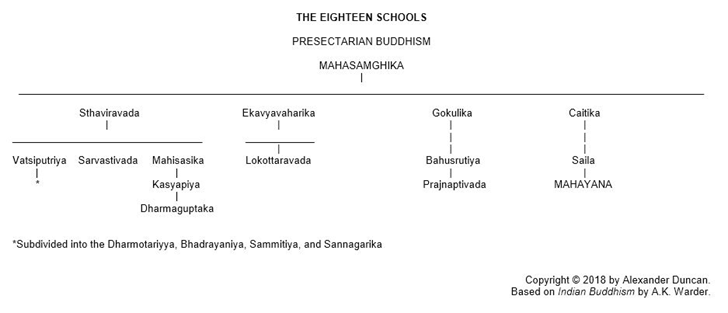
Over the next 300 years, numerous schools and sects emerged, often based on geographic divisions, leading to what are traditionally known as the Eighteen Schools. These schools represent the ways that early Buddhism developed, split, and adapted to different local contexts. The names and doctrines of these schools vary across sources, but for the purposes of this talk, I will be referencing a list compiled by A.K. Warder, a prominent scholar of Indian Buddhism. In his book Indian Buddhism (3rd revised edition, 2000), Warder provides a list of eighteen schools in approximate chronological order, reflecting the state of Buddhist thought around 50 BCE.
Interestingly, this period also marks the first major textualization of the Pali Canon and the emergence of Mahāyāna literature, particularly the Prajñāpāramitā texts. Warder’s list of schools, therefore, corresponds to a significant moment in Buddhist history, one where the early Hinayana schools, which we now refer to as the Eighteen Schools, were becoming more clearly defined in their distinct beliefs and practices.
Though we often hear about the Mahāyāna schools today, it is important to note that these Eighteen Schools, referred to by the Theravada as “thorns on the teaching,” were all part of the early, pre-Mahāyāna tradition. Some prefer to avoid the term Hinayana as pejorative, so I will refer to these schools collectively as the Eighteen Schools throughout this talk, but Buddhist sectarianism predates the Mahayana.
Finally, a word about the diverse perspectives within Buddhist scholarship: While I have followed Warder’s framework, it is important to recognize that opinions and interpretations vary. As with much of early Buddhist history, the picture is far from uniform, and debates continue to unfold in the academic world.
Now, let us turn to the chart I have prepared, which breaks down the development of these schools over the first 350 years of Buddhism, from 400 BCE to 50 BCE. I encourage you to follow along, as it will help you track the development of these early Buddhist schools and understand their historical and doctrinal evolution.
The Eighteen Schools
- Mahāsāṅghika (“Great Assembly”)
The Mahāsāṅghika, meaning “Great Assembly,” is the original majority Buddhist school, and it holds the oldest extant version of the Vinaya—the monastic code— from which the Sthavira minority later split during the Second Buddhist Council (some sources suggest the Third Council). This historical moment is important because it marks the first major schism in the early Buddhist community.
The Mahāsāṅghikas originated in Magadha, an ancient region in northeastern India that was also the home of the Buddha. One key feature of this group is that they opposed the addition of new rules to the Vinaya, showing their resistance to changes in monastic discipline after the Buddha’s passing. They may have also questioned the infallibility of the arhants, the advanced disciples of the Buddha who were believed to have reached the spiritual goal of emancipation.
What is especially interesting about the Mahāsāṅghika is their early formulation of ideas that would later become central to Mahāyāna Buddhism. They hinted at an idealistic view of the universe, where everything—whether nirvana or samsara, the mundane or the supermundane—was a projection of the mind, insubstantial and nominal. This echoes the later Mahāyāna teaching that all phenomena are empty of inherent existence.
In terms of their view on the Buddha, the Mahāsāṅghikas had a distinctive interpretation. They believed the Buddha’s body and mind were supermundane, meaning they were perfectly pure and beyond the ordinary world. This understanding of the Buddha’s transcendent nature became a foundational idea for Mahāyāna Buddhists. In their view, the Buddha’s body, power, and life were unlimited—he was omniscient and immortal, qualities that Mahāyāna thought later fully embraced.
The Mahāsāṅghikas also developed the idea of the bodhisattva, a being who postpones their own entry into nirvana to help others attain enlightenment. They believed that bodhisattvas could deliberately be born into lower realms of existence, not out of necessity but as an act of compassion, to guide sentient beings and awaken the factors of enlightenment in them. This idea of intentional rebirth for the sake of others’ enlightenment became one of the central features of Mahāyāna practice.
In terms of physical landmarks, the Mahāsāṅghikas are associated with the Ajanta, Ellora, and Karla caves—sites that contain Buddhist art and architecture tied to the Mahāsāṅghika tradition. There is also a Chinese historical account that mentions the Mahāsāṅghikas as wearing yellow robes, embroidered with symbols like the endless knot and the conch. These symbols were meant to represent oneness and the Dharma, respectively.
A distinctive feature of the Mahāsāṅghika approach to the teachings was their emphasis on the true or interior meaning of the discourses. They viewed these texts not as external laws but as the source and center of the Teaching, meaning the teachings of the Buddha. In fact, they may have rejected the authority of the Abhidharma, a body of philosophical texts that later became central to some schools of Buddhism. For the Mahāsāṅghikas, language cannot fully capture ultimate realization—it is trans-linguistic.
Additionally, a text called the Samayabhedoparacanacakra attributes forty-eight specific theses to the Mahāsāṅghika and the schools derived from it. These theses highlight the diversity and depth of the Mahāsāṅghika tradition and its influence on the development of early Buddhist thought.
- Sthaviravāda (“Teaching of the Elders”)
Scholars once thought that he Sthaviravāda, which translates as the “Teaching of the Elders,” was the original Buddhist school. Traditionally they believed that the Mahāsāṅghika split off from the Sthavira group over disagreements on monastic discipline.
Specifically, they saw the Sthavira as more conservative, holding to a stricter interpretation of the Buddha’s teachings, while the Mahāsāṅghika were more lenient. However, recent Vinaya studies have shifted this understanding. New scholarship suggests that the Mahāsāṅghika Vinaya is the oldest, and it was the more conservative Sthavira minority that split from the Mahāsāṅghika majority during the Second Buddhist Council. This split occurred largely because the Mahāsāṅghikas refused to introduce new rules to the Vinaya—rules that the Buddha had specifically forbidden.
The Sthavira saw the Mahasanghika rules as too lax, including a wide range of monastic practices, such as:
- Storing salt in a horn;
- Eating after midday or eating more than one meal per day;
- Holding different lunar ceremonies in the same district (these are the observance days for the Buddhist community);
- Conducting official acts without a quorum;
- Following one’s teacher’s practices instead of the larger community;
- Eating sour milk after midday;
- Consuming unfermented wine;
- Using a rug of the wrong size or type; and
- Using money—something that was a controversial issue among the early monastics.
Additionally, the status of the arhant—the enlightened disciple—may have played a role in the conflict. As different schools of thought began to emerge, some questioned whether arhants were truly infallible in their spiritual wisdom, which challenged long-held beliefs within the community.
These debates on the Vinaya, the rules of monastic life, led to the emergence of different schools with contrasting views on discipline, with the Sthavira maintaining a more conservative stance and the Mahāsāṅghikas favoring a more flexible, liberal approach.
- Vātsīputrīya (“School of Vātsīputra”; Pudgalavāda, “Teaching of the Person”)
The Vātsīputrīya, also known as Pudgalavāda, was one of the more unorthodox early Buddhist schools. It emerged in the third century BCE as a split from the more conservative Sthavira tradition. The school is most famous for its radical teachings on the nature of the “person”—a concept that set it apart from other Buddhist schools.
The founder of the Vātsīputrīya school, Vātsīputra, was a Brahman who became a Sthavira. He introduced the idea of an ineffable “person” or individuality that is neither the same as, nor completely different from, the five aggregates (the physical and mental components that make up an individual). According to this doctrine, the person is the basis of rebirth, the subject of karma, and continues to exist even after reaching nirvāṇa.
This teaching was controversial for several reasons. While the idea of an enduring individuality provided an explanation for the continuity of experience, it raised alarms for many in the monastic community. They saw the concept of this “person” as being too like the atman—the self or soul—a central concept in Indian philosophy that the Buddha himself had specifically rejected. According to Buddhist doctrine, there is no permanent, unchanging self, and the idea of a soul is a major obstacle to enlightenment.
Despite facing considerable resistance from other Buddhist groups, the Vātsīputrīya school was popular in certain regions, particularly because its views on individuality and rebirth resonated with some of the cultural ideas circulating in the broader Indian spiritual landscape.
- Dharmottariya (“School of Dharmottara”)
The Dharmottariya school is one of the lesser-known early Buddhist traditions. According to A.K. Warder, not much is definitively known about this group, and much of its history remains obscure.
The Dharmottariya school split off from the Vātsīputrīya school during the second century BCE. Along with the Bhadrayaniya, Sammitiya, and Sannagarika schools, the Dharmottariya was part of a broader movement that caused some fragmentation within the Buddhist community at the time.
This group was based in the Aparanta region, located along the coast of Maharashtra, at the significant port city of Surparaka—which was an important trade hub and capital in the ancient world.
Doctrinally, the Dharmottariya shared many similarities with the Mahasamghikas, the school from which they originally derived. While specific teachings are not well-documented, it is likely that they followed the same general framework of idealistic ontology and a view of the Buddha as transcendent and supermundane—core elements of Mahasamghika thought.
- Bhadrayaniya (“School of Bhadrayana”)
The Bhadrayaniya school was located on the edge of the Maharashtrian plateau, just behind the great port city of Surparaka, an important trading hub in ancient India. Specifically, they were situated in a region known as Nasika.
Though details about the doctrines and practices of the Bhadrayaniya school are sparse, their geographical location places them within the same general cultural and religious milieu as other schools that the Mahasamghikas influenced. This area was known for its interaction with multiple Buddhist sects during a time of significant religious and philosophical development.
- Saṃmitīya (“School of Sammiti”)
The Sammitīya school emerged as a split from the Vātsīputrīya school, which itself was part of the broader Sthavira tradition. According to renowned Buddhologist Étienne Lamotte, the Sammitīya school was one of the largest non-Mahayana sects in India at the time.
One of their key doctrinal positions was the affirmation of the reality of the person, which set them apart from other Buddhist schools that questioned or denied the concept of a permanent self. The Sammitīya were particularly known for their strong rejection of Mahayana teachings.
In fact, they were notoriously anti-Mahayana, even going as far as destroying texts and statues associated with the Mahayana and Vajrayana schools, reflecting their intense opposition to these traditions. This reputation for narrow-mindedness marked them as a sect that was resolutely conservative and focused on preserving what they saw as the true, original teachings of the Buddha.
- Sannagarika (“Dwellers of the Noble City”)
The Sannāgarika school was a minor sub-sect within the early Buddhist tradition, branching off from the Vātsīputrīya lineage, which itself had roots in the Pudgalavāda (“Personalist”) movement. Unfortunately, the exact origins, founder, and detailed history of the Sannāgarika school are not well-documented, meaning that much about their development and place within early Buddhism remains unclear.
As a derivative of the Vātsīputrīya, the Sannāgarika school upheld the central doctrine of the pudgala — a concept of “person” that is neither entirely identical to nor separate from the five aggregates (skandhas). This view sought to address the issue of personal continuity, karma, and rebirth without asserting an unchanging self (ātman), which is a key concept in many Indian philosophies.
However, this perspective was controversial. Other Buddhist schools criticized it for potentially conflicting with the core doctrine of anatta — the teaching of non-self. This tension highlights the struggle within early Buddhism to define the nature of identity and continuity in a way that did not contradict the Buddha’s radical rejection of the eternal self.
Unfortunately, due to the scarcity of historical records and the eventual disappearance of the Sannāgarika school along with related movements, their specific practices, regional influence, and contributions to Buddhist thought remain obscure.
- Sarvastivada (“Teaching that All Exists”)
The Sarvastivada school split from the Sthavira tradition sometime between the reign of Ashoka and the first century CE. The name “Sarvastivada” refers to their central doctrine — the belief that past, present, and future all coexist simultaneously. Interestingly, this doctrine has been revived in modern times due to insights from new physics, which resonate with the idea of time as a more fluid, interconnected reality.
This school flourished in regions like Kashmir and Gandhara, and their canon was composed in Sanskrit. The Sarvastivadins advocated a form of radical pluralism. They rejected the notion of a self as a permanent substance or soul but affirmed the existence of momentary entities called dharmas. They identified seventy-five distinct dharmas, which they believed were final, indivisible, and real.
The Sarvastivadins distinguished between conditioned and unconditioned dharmas. The conditioned dharmas include matter, consciousness, psychological processes, and qualities the things we experience. On the other hand, the unconditioned dharmas include more abstract concepts like space and nirvana.
A key aspect of the Sarvastivada doctrine was their belief that conditioned dharmas have always existed, but they alternate between latent potential and actual manifestation. This belief leads them to assert that everything exists together in a simultaneous past-present-future state.
The Sarvastivadins also emphasized the importance of body, speech, and mind in their teachings. Additionally, they held a particular reverence for Maitreya, the Future Buddha, who plays a key role in their cosmology. The school also accepted the reality of an intermediate state —often referred to as the “bardo” — the period between life and death. The Tibetan Book of the Dead reflects this concept of the bardo, which describes a 49-day post-mortem period, which mirrors the Sarvastivada view of the post-death state.
- Mahīśāsaka (“School of Mahisasa”)
The Mahīśāsaka school originated in the second century BCE. One of their key doctrines was the denial of the existence of the past and future. They believed that only the present moment truly exists, focusing entirely on the immediacy of experience.
They also rejected the idea of the intermediate state, or bardo, which is the transitional period between life and death. However, they did affirm that a subtle mode of the five aggregates — the fundamental components of human experience (like form, sensation, perception, mental formations, and consciousness) — survives beyond death. This subtle aspect continues after death and forms the basis for the next rebirth.
Another distinctive belief of the Mahīśāsakas was that the Buddha is a member of the community of monks and practitioners. This contrasts with other schools that might have considered the Buddha to be beyond the ordinary human community.
- Kasyapiya (“School of Kasyapa”)
The Kasyapiya, also known as the Haimavata after the Himavant country where they originated, split from the Sthaviravada in the second century BCE. A remnant of this school survived until the seventh century. According to a Chinese source, they wore robes made of magnolia.
The Kasyapiya school expanded southward into Sri Lanka, where they established the Mahavihara (Great Abode) in Anuradhapura, the capital of Sri Lanka. One of their key beliefs was that an arhant — a person who has achieved enlightenment — is not yet perfect. Their doctrines shared similarities with the Sarvastivada and Dharmaguptaka schools. These include the belief that past karmas have not yet borne fruit, the focus on the present moment, and the acknowledgment of some aspects of the future. They also held that all compounded things (formed from causes) are destroyed instantly, and that the cause of the compounded exists in the past, while the cause of the uncompounded exists in the future.
According to Vasumitra, the Kasyapiya school was eclectic, blending doctrines from both the Sthaviras and the Mahasamghikas.
- Dharmaguptaka (“School of Dharmagupta”)
The Dharmaguptaka school, founded by Dharmagupta, split from the Mahisasaka school between the late third and early first centuries BCE. They originated in Aparanta, and one of their important centers was the Swat Valley (also known as Uddiyana), which tradition believes was the home of Padmasambhava.
In the first century CE, the Dharmaguptaka flourished in northwest India. They shared with the Sthaviravada school the belief in the incorruptibility of arhants (enlightened beings). A key achievement of the Dharmaguptaka was their success in spreading Buddhism beyond India, reaching Iran, Central Asia, and China. In fact, the Dharmaguptaka became the foundation of Chinese Buddhism, where their Vinaya (monastic rules) continues to be practised today.
The Dharmaguptaka’s influence persisted, with evidence of their existence into the seventh century. They also had two important extra-canonical divisions: the Bodhisattva Pitaka (a collection of teachings on the bodhisattva path) and the Mantra Pitaka (a collection of mantras).
Their key doctrines include:
- A gift given to the Buddha is more meritorious than one given to the order because the Buddha is self-ordained.
- The first three characteristics of compounded things — origination, maturation, and decay — are conditioned, while the fourth, extinction, is unconditioned.
- The path of the Buddhas and bodhisattvas is distinct from the path of the disciples (sravakas).
- Non-Buddhists cannot attain the five kinds of superknowledge, including psychic powers, clairaudience, telepathy, memory of past lives, and the clairvoyant ability to perceive the karma of others.
- The body of an arhant is free from the taints of defilement.
The Dharmaguptaka believed that offerings made to a stupa (a monument containing relics) accrue great merit, and they also embraced the understanding of the Four Noble Truths as a whole. Some of the Prajnaparamita literature had connections with the Dharmaguptaka.
- Ekavyavaharika (“Teaching of the Single Conduct”)
The Ekavyavaharika school split from the Mahasamghika school during the reign of Ashoka in the third century BCE. One of their defining beliefs was the acceptance of the Mahayana sutras as the word of the Buddha.
The Ekavyavaharika held that all principles are cognized in a single instant — meaning that one perceives everything in a unified, transcendental way. For them, the Buddha’s teachings have a single, unified meaning, which transcends ordinary distinctions.
They also believed that sentient beings possess a fundamentally pure mind — a mind that is the same as that of the Buddha. However, this pure mind becomes obscured and burdened by suffering, preventing individuals from realizing their true nature.
- Lokottaravada (“Teaching of the Transcendent”)
The Lokottaravada school arose from the Ekavyavaharika. Their major contribution was the Mahavastu, an unorthodox Vinaya text that brought together many of the Buddha’s biographical traditions for the first time. The Mahavastu depicts the Buddha as transcendent, including his body. While his actions may appear conventional, they do not stem from any real need. Buddhas never experience fatigue, even though they lie down. Dust cannot stick to them, but they still wash their feet. Everything about the Buddha is transcendent.
The Lokottaravada school was centred in north-central or northwest India and continued to thrive until the Turkish conquest of the Pala Empire in the 12th century. One of their core teachings is that the Buddha expressed all his teachings in a single transcendental or supermundane utterance. They also believed that all phenomena are mental constructions with only provisional reality.
The school originated sometime after 200 BCE, and the Infinite Life Sutra, which shares elements with the Mahavastu, shows their influence. A key aspect of their doctrine is the twofold view of emptiness: the emptiness of self and the emptiness of phenomena.
The Mahavastu introduces the Three Vehicles, including the bodhisattva’s path. It describes ten grounds or stages that a bodhisattva progresses through on the way to enlightenment. There are countless pure lands with countless buddhas and tenth-stage bodhisattvas. The Mahavastu also states that Maitreya, the future Buddha, will be one of a thousand buddhas to appear in this age.
- Gokulika (“School of Gokula”)
The Gokulika school, also known by several other names like Kukkutika, Kukkulika, Kaukkutika, and Kaurukullaka, split from the Mahasamghika around the third or late second century BCE. They were known for their specialization in Abhidharma, particularly focusing on logical analysis.
According to the Sthaviravadins, the Gokulika held the belief that there is no happiness. Bhavaviveka, a prominent figure, stated that the Gokulika believed thought is intrinsically pure and radiant, incapable of defilement. They also maintained that at enlightenment, all principles are cognized in a single moment. Additionally, they taught that all principles are merely labels or conceptual constructs.
Unlike schools like the Lokottaravada and Ekavyavaharika, which they are sometimes associated with, the Gokulika did not accept the Mahayana sutras as the word of the Buddha. They remained primarily centered in Varanasi had a presence in Pataliputra. According to Warder, they continued to flourish until the time of the Turkish conquest of the Pala Empire. Some sources, like Taranatha, suggest their influence lasted from the fourth to ninth centuries.
- Bahusrutiya (“Teaching of the Many Hearers”)
The Bahusrutiya school emerged in the third century as a split from the Gokulika over a point of Abhidharma. They were active in regions such as Kosala, Gandhara, Andhra, and northwest India. A monk named Yajnavalkya, who proposed the special doctrine that meditation could prolong life indefinitely, founded the school.
The Bahusrutiya held that all experiences are suffering and that all principles are false, except for nirvana. They believed that the five aggregates (form, feeling, perception, volitional formations, and consciousness) and suffering itself are real, but are also impermanent, not-self, and empty. In their view, even the thought of emptiness ceases in nirvana.
Vasumitra states that the school believed the Buddha’s teachings included a transcendental doctrine with the power to generate the way to liberation. Five key terms summarized the doctrine: impermanence, suffering, emptiness, not-self, and nirvana—with everything else he taught regarded as mundane or worldly.
The Bahusrutiya made a distinction between ultimate truths and concealed truths. According to Warder, the famous Buddhist poet Asvaghosa may have followed the Bahusrutiya school.
The Tattvasiddhisastra (3rd century CE) summarizes their Abhidharma, which includes ideas like the nonexistence of past and future principles, the inherent impurity of thought, the nonexistence of the person, and the reality of unmanifest materiality. They also rejected the concept of an intermediate post-mortem state, or bardo.
The Bahusrutiya took a middle position between the extremes of “everything exists” and “nothing exists.” Their Abhidharma shares similarities with the Sthaviranikaya and Sautrantika schools.
- Prajnaptivada (“Teaching of Denotation”).
The Prajnaptivada school split from the Bahusrutiya in the third century BCE, led by Mahakatyayana, over the “two truths doctrine”. This doctrine argued that there is a distinction between real, ultimate principles and the merely imputed, provisional or conceptual truths that we use in everyday language. They believed that reality is trans-linguistic—beyond the reach of language. Phenomena are the product of conceptualization, which means that, because all phenomena are just concepts or labels, they are inherently suffering
The Prajnaptivada held that there are two levels of statements in the sutras: ultimate and concealing. In this view, the Buddha’s teachings are nominal, conventional, and causal, meaning they are provisional and cannot express ultimate truth. Evidence suggests that this doctrine influenced Nagarjuna.
However, the Prajnaptivada also affirmed that suffering is real. They believed that the Noble Eightfold Path is eternal and immutable and cannot be lost or destroyed. Yet, one cannot cultivate it through contemplation, only through wisdom and merit. Merit and karma are as the driving forces behind everything.
The Prajnaptivada school originated and remained active in the Himalayas, northeast India, Bengal, and Nepal, flourishing especially in the Pala Empire until the time of the Turkish conquest.
- Caitika (“Pertaining to the Mind”)
The Caitika school, also known as Caitiya, Chaitya, or Caityaka, split from the Mahasamghika under the leadership of a successor to Mahadeva in the region of Andhra, which corresponds to modern Andhra Pradesh in India. Their history spans from the second century BCE to the early second century CE. Pali texts sometimes refer to them as the Andhaka.
Some scholars suggest that the Prajnaparamita literature, an important Mahayana text, emerged from the Caitikas, meaning they were active no later than the first century BCE. The initial split was over a legal matter related to Vinaya, specifically about admission to the order. It is also notable that the Mahayana tradition arose in this region during this period.
The Caitikas revived the Five Points of Mahadeva (see below) and, according to Warder, they were ahead of their time, anticipating some key aspects of Mahayana thought. The Andhra schools taught that the Buddha’s discourse is inherently transcendental, ultimate, and supermundane, beyond ordinary words. However, ordinary people might only perceive the conventional, mundane meaning of his teachings. The Caitikas also believed that the Buddha and his disciples could perform miracles, overriding the laws of nature with their powers.
They held that the Bodhisattva could be born in unfortunate circumstances, including as a hell-being, animal, ghost, or demon, and that this birth was of the Bodhisattva’s own free will, not the result of karma. For the Caitikas, the path of the bodhisattva was superior to the path of the arhant, whom they considered fallible and inferior.
The Caitikas are also associated with the tathagatagarbha doctrine—the idea that all beings have the potential to become Buddhas. They seem to have placed significant value on the Jataka stories as prescriptive truths. According to the Sarvastivadins, they split from the Bahusrutiya school. The Caitikas were also connected to the Great Stupa of Sanchi and appear to have had a presence at the Ajanta Caves, especially Cave 10.
- Saila (“Mountain School”)
The Saila school, also known as the Mountain School, split from the Caitika school, forming two branches: the Apara and Uttara (Purva) Sailas. One of their key doctrines was that the Bodhisattva is born certain of attaining enlightenment. This belief emphasized the inherent certainty of the Bodhisattva’s eventual awakening, setting them apart from other schools that might emphasize the Bodhisattva’s journey as more uncertain or gradual.
Summary
According to tradition, Mahākassapa, the disciple foremost in asceticism and the third most important of the Buddha’s disciples after Sāriputta and Mahāmoggallāna (who predeceased the Buddha), convened the First Buddhist Council shortly after the Buddha’s passing, around April 400 BCE. The council most likely took place in July, in response to a liberalizing movement within the monastic order. The gathering occurred near the Sattapanni Cave on Vultures’ Peak near Rājagṛha (modern-day Rajgir). The canon mentions an improbably large number of 500 attendees, but a more realistic estimate might be a smaller, core group of senior monks—perhaps only a few dozen—especially those with direct experience of the Buddha’s teachings, such as Mahākassapa, Ānanda, and Upāli. The focus of the council was not on mass participation but rather on ensuring the authoritative oral transmission of the Dharma and Vinaya.
Even Ānanda, the Buddha’s personal attendant for 25 years, was admitted only at the last minute, despite his critical role in memorizing the Buddha’s teachings. The Vinaya was recited by Upāli, the Buddha’s barber, while the Sūttapitaka (the Buddha’s discourses) was recited by Ānanda. The Abhidharmas were composed later and are sectarian productions. Also, not all schools recognized any “abhidharma.”
The First Buddhist Council was far from harmonious. The Pāli Canon itself indicates that the order was divided and that the council was contentious. The Buddha had stated that minor rules of the Vinaya could be abrogated, and it is clear that he favored the ordination of women, affirming that women could attain emancipation (nirvana). This was a remarkable statement, particularly in late Vedic India, when women were generally regarded as subordinate to men. This implies that, at the time, some people held the view that women were incapable of enlightenment—a view the Buddha sought to correct. Despite his statement, however, the monastics at the council decided to retain all of the Vinaya rules, including the “eight heavy rules,” so-called, which were specifically designed to ensure the subordination of female monastics to their male counterparts. Ānanda, in particular, was criticized by the monastics for defending the ordination of women and for what they perceived as general laxity in monastic discipline.
Over the next 350 years, three more Buddhist councils were held in response to the proliferation of Buddhist schools, which numbered between 12 and 30, depending on how they are classified. The traditional number is 18, with some variations in the historical records. Of these 18 schools, eight were named after their founders, six after important doctrinal principles—such as the Person, the doctrine that All Exists, Single Conduct, the Transcendent, Denotation, and Mind—and three were categorized by their geographical locations or other features, such as the Great Assembly, the Elders, and the Many Hearers. These schools are all considered Hinayana (Lesser Vehicle) schools, as the Mahāyāna tradition did not arise until the first century BCE. This dispels the notion that Hinayana was a unified tradition, as the diverse doctrines of the 18 schools often anticipate many aspects of the Mahāyāna that would later emerge.
When one examines the doctrinal issues addressed by the various schools (as we discussed last week), certain themes recur throughout the debates, including:
- The nature and status of the Vinaya rules;
- The perfection and infallibility of the arhants;
- The nature of the Buddha and whether he is mundane or transcendent;
- The relationship between the Buddha, bodhisattvas, and arhants;
- The nature of truth: Is it linguistic or translinguistic?
- Are the Buddha’s discourses conventional or ultimate?
- The meaning of “not-self”;
- The nature of the mind, Buddha nature, and the tathagatagarbha;
- How karma is transmitted from one life to the next;
- Can bodhisattvas voluntarily choose to be reborn?
- Does a person persist after death?
- Is there an intermediate state between lives?
- The relationship between past, present, and future;
- The nature of phenomenal existence in relation to ultimate reality;
- How is emancipation (nirvana) achieved? and
- Are the Mahāyāna sūtras the authentic Word of the Buddha?
These are just a few of the key questions that emerged from the debates between the schools, highlighting the diversity of thought and the complexity of early Buddhist doctrinal development.
The Five Points of Mahadeva
Mahadeva is a mysterious figure who, according to the Theravadin account, declared Five Points about thirty-five years after the Second Buddhist Council circa 300 BCE. However, some modern scholars have suggested that Mahadeva was the founder of the Caitaka school about two hundred years later, i.e., in the first century BCE. Although the historicity of this account is controversial, there is no doubt that the Five Points refer to an important controversy to do with the perfection of arhants which divided the schools. These points or theses were:
Five Points of Mahadeva:
- Male arhants can have nocturnal emissions: Mahadeva argued that even an enlightened being (arhant) could have involuntary physical experiences, such as nocturnal emissions, which was controversial because it implied that arhants were not entirely free from physical afflictions or desires.
- Arhants can be ignorant: This point suggested that arhants might still possess ignorance in certain areas, even after attaining enlightenment. This was a challenge to the notion that an arhant would be completely free from ignorance.
- Arhants can doubt: Mahadeva proposed that arhants could still experience doubt, even though they had achieved enlightenment. This was another challenge to the idea that an enlightened being would be free from all mental afflictions, including doubt.
- Arhants need guidance: Mahadeva posited that even arhants might need guidance or help from others on the path, which was a controversial assertion, as many believed that once someone attained the status of arhant, they were fully self-sufficient in their wisdom and spiritual progress.
- Arhants may attain the path by means of a verbal ejaculation: This point suggested that arhants could attain enlightenment or the path to it simply through a verbal utterance, such as a sudden insight or exclamation, which was a low or simplistic way of reaching spiritual realization.
The gist of the first four of these points is that arhants are imperfect and fallible and therefore cannot represent the highest stage of the Buddhist path. As we have seen, the schools were divided on this question, including several Sthavira schools. The oldest Sthavira school to hold this view of the imperfection and fallibility of arhants was the Sarvastivada. The Sarvastivada also criticized the Mahisasaka view concerning the inferiority of women. In both respects, the Sarvastivada exhibits similarities to the Mahasamghika school, despite being a school in the Sthavira line. Warder dates the secession of the Sarvastivada from the Sthavira during the reign of Ashoka (third century BCE).
Views on Arhants
One of the most interesting things that emerges out of the foregoing study is the position of the early schools (all pre-Mahayana, remember) on the status of arhants. We think of arhantship as the goal of the Buddhist path, based on the Pali Canon, the only surviving complete early Buddhist canon, preserved by the Theravada school, yet the picture appears very differently when we catalogue the positions of the early Buddhist schools on this question.
The Sarvastivada, Kasyapiya, Dharmaguptaka, Mahasamghika, Ekavyāvahārika, Lokottaravāda, Bahuśrutīya, Pajñaptivāda, and the Caitika schools all regarded arhants as imperfect in their spiritual attainment compared to buddhas and therefore fallible, despite their being emancipated. This ambiguity or paradox has to do with the doctrine of interconnectedness, as I have explained in previous talks, as well as the historical fact of the primogeniture of the Buddha. Significantly, three of these schools fall under the conservative Sthavira, the same school with which the Theravadins identify themselves. Even the Mahisasakas – another Sthavira school – also appeared to believe that women could become arhants, but not buddhas, implying that arhantship is inferior to Buddhahood. There was no consensus on this point. We think of arhantship as the goal of the Buddhist path, although the Pali Canon itself clearly considers Buddhahood to lie beyond arhantship, because this is the view of the Theravadins.
The Buddha also prescribed different spiritual strategies for different people, based on their personal predilections and stages of development, including intentional rebirth, divine rebirth, and rebirth in the Brahma worlds, which are clearly not the highest goal according to the Buddha. There is even an arhant rebirth (in the Pure Abodes). The loving-kindness meditation, which the Pali Canon often mentions, by itself does not seem to lead to arhantship. As we have shown in this paper, the Theravadin claim to be identical with presectarian or original Buddhism is historically false. On the other hand, the doctrine, associated with Mahadeva, that arhants are imperfect and fallible explains certain difficulties with the arhant concept in the Pali Canon, including the fact that it is a non-Buddhist concept generally (but not universally) associated with an intermediate stage of realization (e.g. by the Jains) and the Buddha’s statement and the evidence of the Pali Canon that it could be achieved relatively easily, in as short a time as one week, which seems an awfully short time to achieve the complete transcendent self-perfection that the Buddha took eons to attain, even with the aid of the Buddhist teaching.
The Forty-Eight Doctrines of the Mahasamghikas
When Martin Luther decided to challenge the dogmas of the Roman Church in November 1517, he summarized his “disputation” in ninety-five theses, which he nailed to the front door of the All-Saints Church in Wittenberg. Similarly, the Doctrines of the Different Schools (Samayabhedoparacanacakra) of Vasumitra records forty-eight special theses attributed to the Mahāsāṃghika, Ekavyāvahārika, Lokottaravāda, and the Gokulika schools. Vasumitra was a monastic who led the Fourth Buddhist Council in Kashmir about the first or second century and helped to compile the Great Commentary of the Abhidhamma. Whether this is the same Vasumitra who wrote the Doctrines of the Different Schools is unclear. The book exists in English translation under the title Origins and Doctrines of the Early Indian Buddhist Schools. The book summarizes the 48 doctrines on pages 18 to 32. In simplified summary form, they are as follows:
- Buddhas are transcendent.
- The Tathagata is undefiled.
- Tathagatas preach the righteous law.
- The Buddha can expound all doctrines in a single utterance.
- The speech of the Buddha is always true.
- The “bliss body” of the Buddha is infinite.
- The divine power of the Tathagata is infinite.
- The Buddha is immortal.
- The Buddha never tires of enlightening beings.
- The Buddha neither sleeps nor dreams.
- There is no hesitation when the Buddha answers a question.
- The realization of the Buddha is trans-linguistic.
- The Buddha understands everything at once.
- The wisdom of the Buddha is infinite.
- Buddhas know that they have extinguished all defilements and will not be reborn.
- Bodhisattvas are not born in the usual, mundane way.
- The appearance of a white elephant indicates the bodhisattva’s final birth.
- Bodhisattvas are born through a special means.
- Bodhisattvas do not harbour thoughts of greed, anger, or harming others.
- Bodhisattvas may be reborn in good or bad states to help others.
- One who has realized truth can meditate on all aspects of the Four Noble Truths simultaneously.
- The five sense consciousnesses conduce to both passion and dispassion.
- Beings in the form and formless worlds possess all six sense consciousnesses.
- The five sense organs in themselves are impercipient.
- One can speak even in a meditative state.
- Perfected beings are unattached.
- Stream entrants know their own state.
- Arhants are subject to temptation, ignorance, and doubt; they are still dependent on others, and one realizes the path through utterances.
- Suffering leads one to the path.
- The words of suffering can help one realize the path.
- By wisdom, one annihilates suffering and experiences bliss.
- Suffering is a kind of food.
- One can remain in a meditative state indefinitely.
- A Buddhist in an advanced state of realization can still retrogress.
- A stream-entrant can retrogress, but an arhant cannot (because they have no passions).
- There is no worldly right view or right faith.
- Everything is good or bad; nothing is morally neutral.
- A stream-entrant has destroyed all bonds.
- A stream entrant cannot commit matricide, patricide, murder of an arhant, causing a schism, or cutting a Tathagata.
- All Buddha discourses are inherently perfect.
- There are nine ultimate or absolute things: extinction realized by wisdom, extinction not realized by wisdom, ordinary space, infinite space, infinite consciousness, nothingness, neither perception nor non-perception, moral causality, and the teaching.
- Mind is inherently pure.
- Subconscious passions are neither mental nor do they become conscious.
- Conscious and unconscious passions differ.
- Past and future are not real.
- Mental objects can be known or understood.
- There is no intermediate state of existence between death and rebirth.
- Stream entrants are capable of meditation.
Theravāda’s Claim to Historical Primacy
The modern Theravāda school — often referred to as the “Doctrine of the Elders” — traces its origins to Sri Lanka, where Buddhaghosa systematized and formalized its teachings in the 5th century CE. This tradition retroactively identified itself with the Vibhajjavāda school, the Sri Lankan branch of which Mahinda, the son (or brother) of Emperor Ashoka, established in the 3rd century BCE. Initially, this lineage was known as the Tamraparṇīya, meaning “the Sri Lankan lineage.”
Notably, A.K. Warder does not include the Tamraparṇīya or Theravāda in his list of the eighteen early Buddhist schools in his book Indian Buddhism. The World Fellowship of Buddhists conference only formally adopted the term “Theravāda” itself much later, in 1950.
Doctrinal disputes within the tradition led to the formation of three main sub-schools, each named after its associated monastery: the Mahāvihāra, Abhayagiri-vihāra, and Jātavana-vihāra. According to Chinese sources, Mahāyāna Buddhism was also practiced in Sri Lanka as early as the 7th century CE. The Mahāyāna followers were associated with the Abhayagiri monastery, while the so-called “Hīnayāna” Buddhists were centred around the Mahā monastery. The Jātavana monastery, while traditionally aligned with the Mahāvihāra school, also played a significant role in these doctrinal divisions, particularly as it became a point of intersection between the competing sectarian views during this period. These divisions reconciled in the 12th century, following the intervention of Sri Lankan kings, under the guidance of two forest monks from the Mahāvihāra school. The reunification of these sub-schools cemented the association between Theravāda Buddhism and Sri Lankan nationalism.
Historically, the Tamraparṇīya/Theravāda emerged as an offshoot of the Vibhajjavāda school, which, in turn, descended from the Sthavira faction. The Sthavira school was one of the groups that split off from the Mahāsāṃghika school, via six intermediate schools. As I have previously discussed, this schism violated Buddhist ecclesiastical law, implying that all subsequent developments within these schools are illegal. Therefore, the Theravādins, in claiming direct succession from the original, pre-sectarian Buddhism, face a challenge to their dogmatic claim to represent the unbroken, original teachings of the Buddha.
Thus, Theravāda Buddhism stands as one of the most recent of the so-called “early” schools of Buddhism.
Theravadins consider buddhas and arahants to have reached the same level of spiritual development; thus, arhants must be perfect and infallible. As I have shown, this view was by no means universally accepted by the early schools. Since the arhants of the First Buddhist Council and the Pali Canon itself were extremely misogynistic, this commits modern Theravadins to the view that women are spiritually inferior to men, a position still held in Thailand. The female monastic order died out in Sri Lanka during the thirteenth century. Some scholars consider Theravada Buddhism to be a composite of many separate traditions, overlapping but still distinct. The Theravadin Vinaya, with 227 rules for monks and 311 for nuns, both enshrines the misogyny of the First Buddhist Council and preserves a larger number of rules than the Mahasamghika, for which reason the Mahasamghika Vinaya is considered the oldest Vinaya extant (the original Vinaya is believed to consist of only 152 rules). Mahakassapa says that a larger number of rules indicates degeneracy, not spiritual superiority, contrary to popular thinking today, which also corresponds to the historical account of the Pali Canon.
According to Ajahn Sucitto, a British-born Theravada Buddhist monastic,
It wasn’t originally a counterpoise to Mahāyāna, although it became subsequently defined, and has defined itself, as such. In fact, the terms ‘Mahāyāna’ came into being around the first century, long before the term ‘Theravāda’ was applied to a ‘school’ of Buddhism. The German scholar, Hermann Oldenberg referred to ‘Theravada’ to describe the Pali Vinaya texts he was translating – and published in 1879, but it wasn’t until the early years of the twentieth-century that the term ‘Theravāda’ was employed (by the English bhikkhu, Ven Ananda Metteyya) to describe the Buddhists of Sri Lanka, Burma and S.E. Asia. Even then the term was not officially used in the Asian homelands until the gathering of the World Fellowship of Buddhists in Colombo in 1950.
Theravada Buddhism experienced a series of collapses and revivals. Each time, the tradition became more consolidated, which of course also implies a loss of diversity. This phenomenon of simplification over time is well-known to students of hermeneutics. According to Ajahn Sucitto, the Sri Lankan female monastic order disappeared during the eighteenth century and had to be revived from Thailand. This is the oldest lineage in Sri Lanka today – a mere three hundred years old.
David Chapman, in his essay, “Theravada Reinvents Meditation,” notes that
in the early 1800s, vipassana had been completely, or almost completely, lost in the Theravada world. Either no one, or perhaps only a handful of people, knew how to do it. Vipassana was reinvented by four people in the late 1800s and early 1900s. They started with descriptions of meditation in scripture. Those were vague and contradictory, so the inventors tried out different things that seemed like they might be what the texts were talking about, to see if they worked. They each came up with different methods. Since then, extensive innovation in Theravada meditation has continued. Advocates of different methods disagree, often harshly, about which is correct. …
In the mid-1800s, these texts were revered because supposedly they showed the way to nirvana. However, the way they were practiced was for groups of monks to ritually chant the text in unison. This is like a bunch of people who don’t know what a computer is reading the manual out loud, hoping the machine will spring to life, without realizing you need to plug it in. …
In the 1880s, there is no evidence that anyone in Sri Lanka knew how to meditate. One biography of [Anagarika] Dharmapala [a Sri Lankan Buddhist revivalist and writer] says flatly that “the practice had been neglected and then forgotten.” It’s possible that there were a few monks somewhere who still practiced vipassana, but there is no evidence for that. We do know that he travelled extensively in Sri Lanka, and “in spite of all his enquiries he never succeeded in finding even a single person, whether monk or layman, who could instruct him in… meditation practices.”
Chapman makes two further points that are of interest here:
- Asian Theravada repeatedly reinvented meditation under the influence of Western ideas.
- Men who were “into” extreme asceticism, which the Buddha expressly forbade, reinvented Theravada meditation. This fascination with asceticism continues in Theravada today, which (it is quite clear) has unfortunately also become associated with religious fascism, especially in Sri Lanka, Myanmar, and Thailand.
Appendix
Since writing the foregoing Hajime Nakamura’s exceptionally valuable book, Indian Buddhism (1980), has come to my attention, including his summaries of Original and Early Buddhism (op. cit., pp. 57-82). Although Nakamura gives no specific dates, one may identify Original Buddhism with pre-sectarian Buddhism, whereas Early Buddhism may be identified with the Early Buddhist Schools, say, after the Second Buddhist Council circa 300 BCE to Ashoka’s death circa 232 BCE . I have summarized his synopsis of Original Buddhism in my essay on “The Oldest Buddhist Scriptures.” Here I will summarize his material on Early Buddhism to complement the foregoing. This is the most accurate and succinct synopsis I know of.
DOCTRINE
- Metaphysical questions were forbidden.
- The Buddha had no desire to compete polemically with other sects.
- There is a concept of “meaninglessness statement” in the Pali nikayas.
- The first problem Buddhism took up was suffering, defined as “things not working as one wants them to.”
- Buddhism was empiricist.
- Nothing is permanent. There is no permanent metaphysical substrate. All things are temporary existences that are changing always. [My note: This is an extraordinary insight that presages process philosophy, which did not come into its full flowering until the 20th century .]
- The doctrine of non-self – the attitude of not assuming anything as Self except one’s Self – eliminates selfish desires. It is enlightenment itself. Buddhism did not deny the Self as such. Paradoxically, Buddhism aimed at establishing existential subjectivity or individuality by the negation of the ego. The realization of the True Self was striven for. One can interpret the practice of Buddhism as the formation of the True Self, like the teachings of the European mystic George Ivanovitch Gurdjieff.
- Atman is often referred to with – compared to – light, as in the early Upanishads.
- Buddhism assumed the reality and existence of transmigration. [My note: despite the apparent desire by some so-called modern or Western Buddhists to discard the theory of rebirth].
- Dharma is the fundamental conception of Buddhism. The Buddha sees dharma. Dharma denotes a norm and whatever the norm regulates. Dharma replaces the Upanishadic concept of Brahman. Even defilements were dharmas.
- Human existence divided itself into corporeality (matter or its attributes), feeling, perception, mental formations, and consciousness. One does not find the ego anywhere.
- The problem of the subconscious was especially important. Nakamura compares it to depth psychology (Jung).
- The Four Noble Truths represented the first systematized teaching.
PRACTICE
- The practical implication of the First Noble Truths is the Middle Way or the Noble Eightfold Path, which begins with seeing the dharma (Right View).
- The Middle Way is the basis of ethics, which avoids attachment to the extremes of asceticism or hedonism. [My note: Here we see the root of the doctrine of non-duality or trans-duality, pace Bhikkhu Bodhi.] The basis of Buddhist ethics was universal loving kindness or benevolence. Buddhism held that the value of moral conduct can be determined by the motive (intentionality) of the actor [My note: as distinct from the Jain emphasis on action].
- Various formulas of Interdependent Origination appear in the early Buddhist scriptures. The interdependence between discriminative consciousness and volitional activities is the basic nexus of all subject-object relationships. It reveals the inner working of the mind, through which conversion from ignorance to enlightenment becomes possible. The twelve-link formula resembles Samkhya-Yoga and Jainism. The essential purport of the theory is causality (the law of karma). Sickness is inherent in human existence.
- Ignorance is fundamental, but knowledge or cognition can annul it, resulting in enlightenment.
- The concept of bodhicitta appears in Pali as annacitta (“the thought of gnosis, the intention of gaining arhantshp”).
- Nirvana is absolute nothingness and perfect peace. The distinction between nirvana and parinirvana came later. The concept of void is a key point for early Buddhism. Deliverance is freedom.
- Early Buddhists refrained from defining ultimate reality. Everything is provisional.
- Buddhist doctrine was not systematic. The teaching and method of teaching, including the use of parables and similes oriented to lay people, differed according to the mental ability of the individuals addressed.
- Buddhist cosmology was systematized gradually.
- Buddhism held the idea of three evil realms of hells, hungry ghosts, and animals, but there was no concept of eternal damnation.
- Mahayana ideas, including void, consciousness, and thought are in the Pali scriptures.
- Early Buddhism was not closely organized.
- People did not always regard Gotama as the leader of Buddhism. E.g., the Jains regarded Sariputta, who emphasized compassion and opposed severe austerity, as the leader of Buddhism.
- The nuns’ order predates the building of permanent monastic institutions.
- The original Vinaya consisted of 152 rules, regarded as a sort of education. The Vinaya for nuns came later.
- Early Buddhism advocated the equality of men and women.
- Early Buddhist monastics lived alone, simply, in remote dwellings, and avoided worldly entanglements.
- There were many solitary ascetics in early Buddhism, called paccekabuddhas (as in Jainism). They lived in forests, caves, deserted places, and hermitages, and practised meditation, consisting of various kinds of meditations and meditative attainments. Monastics recited sacred phrases in ceremonies as a form of meditation. The goal of meditation was nirvana, defined as mental stillness and understanding things as they are, including the fundamental impurity of the body (meditation on the body as a corpse). Mystical powers were ascribed to advanced monastics, but magical practices were forbidden. The primary samadhi was meditation on the Buddha.
- Monastics wore three yellowish-red robes, a common colour of ascetics’ robes at the time.
- Buddhism repudiated animal sacrifice.
- There were only Four Precepts originally. The consumption of alcohol came later. Buddhists did not prohibit meat eating, but they did prohibit eating onions.
- Some scriptures asserted that lay people or householders could attain arhantship/nirvana, but the question was controversial. [My note: Multiple householders in the Pali Canon attained arhantship, including at least one non-celibate householder.]
- Circumambulation was practised [My note: cf. walking meditation.]
- Lay practice focused on giving alms, observing precepts and expecting to be reborn in a higher world or dimension (“heaven”), especially by means of altruistic philanthropy. Altruistic philanthropy directed to holy people was especially efficacious. Lay people and even monastics (?) practised donation of things and properties. [My note: How, if they were vowed to poverty?]
- Medicine could cure diseases, sometimes in combination with “magical formulas” [My note: mantra yoga again!]. They also believed that the Buddha’s mercy or meditation on the Buddha could cure diseases.
- Buddhism originally had no gods. They regarded nagas as demigods, part serpent and part god.
- Some monastics rebelled against the discipline of the Buddha and even defied the authority of Gotama. [My note: Thus, there were competing groups of Buddhists. See also my summary of Original Buddhism, Point 11.]
Bibliography
Chapman, David. “Theravada Reinvents Meditation.” https://meaningness.wordpress.com/2011/07/07/theravada-reinvents-meditation.
Dhammika, S. Broken Buddha: Critical Reflections on Theravada and a Plea for a New Buddhism. http://www.buddhistische-gesellschaft-berlin.de/downloads/brokenbuddhanew.pdf.
Nakamura, Hajime. Indian Buddhism: A Survey with Bibliographical Notes. Japan, 1980; rpt. Delhi: Motilal Banarsidass, 1987.
Natier and Prebish. “Mahasamghika Origins: The Beginning of Buddhist Sectarianism.” http://lirs.ru/lib/Mahasamghika_Origins.Prebish.pdf.
New World Encyclopedia. “Theravada Buddhism.” http://www.newworldencyclopedia.org/entry/Theravada_Buddhism.
Sucitto, Ajahn. “What is Theravada?” http://ajahnsucitto.org/articles/what-is-theravada-2012.
Sujato. “Bhikkuni Sangha and the Authenticity Project.” http://secularbuddhism.org/2013/05/04/episode-167-bhikkhu-sujato-bhikkhuni-sangha-and-the-authenticity-project.
Sujato and Brahmali. “Authenticity of the Early Buddhist Texts,” http://ocbs.org/wp-content/uploads/2015/09/authenticity.pdf.
Vasumitra. Origin and Doctrines of Early Indian Buddhist Schools. Trans. Masuda. https://www2.ihp.sinica.edu.tw/file/1143INtSgsf.pdf.
Warder, A.K. Indian Buddhism. http://www.ahandfulofleaves.org/documents/Indian%20Buddhism_Warder_1970-2004.pdf.
Wikipedia: Bahusrutiya, Caitika, Dhammaguptaka, Ekavyavaharika, Kasyapiya, Kukkutika, Lokottaravada, Mahasamghika, Prajnaptivada, Pudgalavada, Sarvastivada, Sthavira nikaya.
Notes
[1] This is the prevailing modern interpretation. However, some scholars interpret the Pali in the opposite sense.
[2] Many modern scholars doubt the story that Ananda had to convince the Buddha to admit women to the sangha based on his reluctance to ordain his stepmother, Mahapajapati, based on contrary evidence in the canon that a nun’s order (bhikkunisangha) already existed when Mahapajapati presented herself to the Buddha. The account also makes no “theological” sense, since it implies that the Buddha was irresolute and did not know his own mind. The overall evidence of the canon is that the Buddha did not discriminate against women and ordained women on an equal basis with men. It is, however, possible that the Buddha delayed creating the bhikkunisangha for a time due to social prejudice.
[3] The eight “heavy rules” (garudhammas) for nuns include inconsistent textual references that indicate that they were not instituted by the Buddha, including references to a probationer ordination that did not exist at the time of Mahapajapati’s purported ordination.
[4] The bhumis are characterized by the realization of joy, elimination of defilements, illumination, wisdom, meditation, emptiness, cessation, arhantship, dharma realization, and finally self-perfection.
[5] To recap, the chain of “interdependent origination” (paticca + sam + uppada) includes two links (nidanas), craving (tanha) and ignorance (avijja), which are subject to intention, thus two points where the chain can be broken, resulting in liberation. Contact comes at the approximate midpoint of the chain, resulting from feeling and giving rise to clinging (desirous attachment), and is reversed through the practice of dispassion. Ignorance is the first link and therefore the root or “first cause” of the chain, resulting from birth, ageing, suffering, and death (interpreting the diagram as a cycle or “circle”) and giving rise to “constructive activities” (sankharas), and is reversed through the practice of wisdom, which is both the beginning and the goal of the path (Right View). Wisdom or gnosis is the essential salvific principle, from which dispassion automatically follows. Interestingly, these two accomplishments, dispassion and wisdom, correspond exactly to the two stages of emancipation, the arhant and the Buddha respectively, with the Buddha preeminent due to the singular role of ignorance in the chain, which we see reflected in the primogeniture of the Buddha and the dependence of the arhants upon him.
[6] 344 years if one accepts the traditional Theravadin date of the parinibbana of 544 BCE.
[7] “Early Buddhists believed that by the attitude of not assuming anything except one’s Self as Self, one could get over sufferings. Paradoxically speaking, Buddhism aimed at establishing the existential subjectivity or individuality by the negation of the ego. The realization of the true Self was striven for. Buddhism did not deny the self as such, contrary to the general assumption by many scholars who tend to regard the theory of Non-Self as a sort of nihilism.” (Nakamura, Indian Buddhism, pp. 63f.).
 Dharmata