
This talk was presented at Buddhism Central on Thursday, February 24 and March 3, 2022.

Thanks to Ankh Jos Joszpe for supporting the research that made this talk possible.
PART I – Historical Section
The Earliest Texts About Padmasambhava
In this talk I will be discussing the life and teachings of Padmasambhava (ca. 710-ca. 797; all dates refer to the common era [CE] unless noted otherwise), the 8th century Tantric mystic from Oddiyana who is credited with converting the Tibetan people to Vajrayana Buddhism. Most modern scholars and Tibetan sources identify Oḍḍiyāna with the Swat Valley in present-day northern Pakistan, especially around the areas of Mingora, Barikot, and Udegram — a region historically part of Gandhāra, rich in Buddhist art and archaeological ruins.
Although most scholars believe that Padmasambhava was an historical person, the details of his life and teachings have been obscured by centuries of hagiography. Here I will try to get at the basic details of Padmasambhava’s work, by focusing on the four oldest-known texts pertaining to him, including material that may go back to the ninth century, less than a hundred years after Padmasambhava’s departure from Tibet about 774/775. These are, in the order in which we will be discussing them:
The Testament of Ba: The Royal Narrative Concerning the Bringing of the Buddha’s Doctrine to Tibet, the oldest history of Tibet, which refers to Padmasambhava.
Taranatha’s Life of Padmasambhava, properly entitled The Document Which Clarifies, Possessing a Threefold Reliability.Taranatha was a renowned 16th–17th century Tibetan scholar who sifted through much older material to arrive at the most accurate biography of Padmasamhbava he could construct, and which specifically avoids many later hagiographical tales, e.g., the miraculous birth of Padmasambhava in a lotus flower at the age of 8, etc.
A Garland of Views, which is generally accepted as having been composed by Padmasambhava himself.
A Noble Noose of Methods: The Lotus Garland Synopsis, a tenth century Tantra and accompanying commentary, which may have been written by Padmasambhava or is certainly closely related to him.
There are of course inconsistencies in the various sources. I have not attempted to smooth these out but have let them stand as they appear in the originals. Nevertheless, one can get a general impression both of Padmasambhava’s life and, more importantly, his teachings from these materials.
This talk will be divided into two one-hour sessions, and will also be posted on my blog at palisuttas.com, including appendices and notes.
The Testament of Ba
The Testament of Ba is an old Tibetan account of the establishment of Vajrayana Buddhism in Tibet and the foundation of Samye Monastery during the reign of King Trisong Detsen (r. 755–797/804), attributed to Ba Salnang (mid-late 8th cent.), who belonged to the king’s court. The earliest known versions of the text are dated to the 9th or 10th centuries, reasonably close to the time that it describes and includes the earliest historical references to Padmasambhava. Specifically it describes the struggle to establish Buddhism in Tibet, the first and second invitation of Santaraksita (725–788), trips to China in search of the teaching, the Bon-Buddhist debate, the invitation of Padmasambhava, who was forced to leave the country prematurely, the construction of Samye monastery, the Samye doctrinal debate, scriptural translations, and the sorrow and regrets of the old king. Padmasambhava returned to Tibet with Santarakshita (c. 725-788) on his second visit, accompanied by a Nepalese architect-geomancer. Particularly notable is the relative absence of supernatural elements in the treatment of Padmasambhava, who was expelled from Tibet by the king because he was suspected of sedition, possibly related to his efforts in the area of water engineering, which threatened the local power structures. There is no reference to special teachings or concealed texts, nor does he participate in the establishment of Samye monastery. Nevertheless, he was credited with being adept in mirror divination and referred to as an expert in mantra, or mantra Yana, a synonym for Vajrayana. due to its extensive use of mantra yoga. These measures were cut short by mounting pressure from the ruling aristocratic establishment that opposed Padmasmabhava. As a result the king asked him to leave, and an assassination attempt was even made against him. Before he left Tibet, Padmasambhava predicted that sectarian divisions would afflict Tibet. This was followed by the Great Samye Debate (792-794), as a result of which the king declared that Tibet would follow the gradualist school of Indian Buddhism associated with Nagarjuna rather than the Chinese Mahayana doctrine of sudden enlightenment (subitism). Chinese Buddhism was repressed, which the king apparently regretted at the end of his life. The reign of King Trison Detsen was followed by an “era of fragmentation” (c. 842-c. 1247) during which time Tibet fell into anarchy. According to the Testament of Ba, all this occurred before the Buddhist-Bon debate, the construction of Samye monastery, and the Samye debate.
Taranatha’s Life of Padmsambhava
Taranatha’s Life of Padmasambhava, properly called “The Document Which Clarifies, Possessing a Threefold Reliability,” is the most authoritative biography of Padmasambhava available, written by a prominent lama of the Jonang school of Tibetan Buddhism, who lived between 1575 and 1634. Taranatha himself states that he wrote the Life at the age of 36, so it must have been written in or about 1611. Taranatha was reputedly born on the birthday of Padmsambhava, which is celebrated by the Tibetans on the tenth day of the fourth or sixth lunar month (traditions differ). This year Guru Rinpoche Day is observed on July 5. Although it was written more than eight hundred years after the events it describes, Taranatha was renowned for his scholarship during his lifetime, and he also wrote History of Buddhism in India. As he says himself, he studied numerous oral traditions that were circulating about the life of Padmasambhava, and only accepted those that he found the oldest and most credible. Thus, his book is based on a critical evaluation of much older traditions. I have not been able to locate a critical edition of the Life in English. For this talk I have used a popular, self-published English translation, which appears to be dependable despite its absence of a critical apparatus.
Buddhism reached its height in India during the Pala Empire, which originated in Bengal. Its rulers were followers of Mahayana and Tantric Buddhism. It was founded with the election of Gaupala as the emperor of Gauda in 750. The empire reached its peak under Dharmapala (c . 770–c. 810/815) and Devapala (c. 810–c. 850). About the same time, King Hayalila ruled Oddiyana.
Padmasambhava was the secret initiatory name of the son of a scholar of rhetoric in Oddiyana and a member of the royal family, Srigdhara by name, meaning “one who wears a flower garland.” Padmasambhava had at least six marks of a Buddha, including a rosy complexion, the figure of a lotus on his ring finger, eyes and lips that looked like lotus flowers, and the figures of an Utpala flower, hook, and lasso on his body, in addition to other marks such as a lotus and a vajra between his eyebrows. Like to the Buddha, after his birth the Brahmans examined his birth marks (physiognomy). Some predicted that he would become a king, others a prince, and others that he would live in cemeteries. Everyone agreed that he would be powerful. A visiting yogi predicted that he would become an advanced Tantric practitioner who would receive his power from Amitabha (lit. ”Infinite Light”), the Buddha of Immeasurable Light and Life.
As he grew up Padmasambhava studied writing, dialectics, medicine, and handicrafts, and took refuge in a monastery where he took the five basic vows, studying Abhidharma and Sutra. He was also initiated into inner, secret Tantra by Shantigupta, a senior teacher, into Kriya (lit. “action, deed, effort”), Ubhaya (“dual”), and Yoga Tantra. Patanjali defines Kriya as consisting of asceticism, study, and devotion. Ubhaya combines ritual and meditation, whereas Yoga focuses on meditation. Padmasambhava studied with a siddha (lit. “perfected one”) called Sukhadeva, who had achieved self-identity with Avalokiteshvara, the androgynous Buddha of Compassion, and the realization of non-duality. He also studied with a prostitute named Sukhadhari, who embodied Vajradhara (lit “diamond thunderbolt”), the Primordial Buddha.
Padmasambhava’s practice of mantra yoga was accompanied by many bad omens, and vivid dreams of many Buddhas and Bodhisattvas all transforming themselves into Amitabha. He also experienced a vision of Hayagriva (lit. “having the neck of a horse”), a wrathful nature spirit associated with Avalokiteshvara, surrounded by a retinue of female spirits or demons, and minor spirits, similar to the Buddha’s experience with Mara. He was also skilled in politics and astrology.
By this time King Hayalila had died and his position take over by his son, Akshalila, who was also devoted to the teaching. However, one of his scribes and two ministers conspired to take over the country, and convinced the king that Padmasambhava was actually engaged in a plot to take over the country, along with a thousand monks. He was expelled, and wandered for a long time, meditating in many cemeteries and practicing mantra yoga, experiencing many visions and acquiring psychic powers. Thus he became a Vidyadhara (lit. “knowledge or awareness holder”), an expert in esoteric knowledge or gnosis. Padmasambhava aspired to Buddhahood itself, but Amitabha appeared to him in a dream and warned him that his use of wrathful and powerful methods (sorcery?) was creating obstacles to his realization of the Absolute.
Padmasambhava went to Magadha, the great Buddhist centre of India, where the Buddha himself lived and taught, which was now being ruled by King Dharmapala, the son of Gopala, and the grandfather of Devapala, under whom Magadha had reached its greatest power. Dharmapala reigned from 770 to 810. Taranatha states that Dharmapala had been reigning “for a long time.” Padmasambhava became a disciple of Shrijnana, the abbot of the monastery of Chokyi Myuku. Srijnana ordained Padmasambhava in the Mahasamghika Buddhist lineage, the oldest Buddhist school. Many scholars regard the Mahasamghika as the precursor of the Mahayana. There he practised Vinaya and studied the Prajnaparamita (lit. “the Perfection of Transcendent Wisdom”), the oldest Mahayana tradition which originated in about 100 BCE and is older than the Pali Canon. As a result, Padmasambhava’s view became like Space. He was also initiated in multiple Tantras, including the Assembly of Secrets, the Net of the Magical Manifestation, the Essence of the Secret Moon, the Tantra of the Unification of the Buddhas and the Garland of Actions, as well as the five classes of Inner Tantra, reaching the Absolute. Padmasambhava is regarded by the Nyingma school of Tibetan Buddhism as a Second Buddha.
Shrijnana sent Padmasambhava east to the country of Bengal to meditate on the Heruka, enlightened beings in Vajrayana Buddhism that adopt a fierce countenance to benefit sentient beings, also called Wisdom Kings, representing the embodiment of indivisible bliss and emptiness.
Here he found a female consort where they trained in the union of creative visualization and inner mandala (lit. “universe”), during which he experienced visions of many Buddhas. He realized the supreme Mahamudra (lit. “the Great Seal”), the realization of the inseparable unity of wisdom and emptiness. He manifested the Vajra or subtle body, also known as the Body of Light.
As a result of these varied attainments Padmasambhava formulated bodhicitta, the will to help all suffering sentient beings through the attainment of an enlightened mind. Padmasambhava taught in northern India and Nepal for several years. He travelled to Bodhgaya, where the Buddha was enlightened, to establish a meditation place, opposing spiritualism and establishing the Buddhist philosophy, taking a female yogi called Ngentsulchen as his consort. He also appointed a yogi named Ratnashila as his personal assistant. Both of these realized themselves as a ‘holder of esoteric knowledge.’ Finally, he returned to Oddiyana, where together with other disciples they built a temple. However, although there were many Buddhists the area was beginning to be overrun by Muslim armies who were destroying or conquering Buddhist schools, which had begun in the late 7th century.
Padmasambhava’s fame spread, especially in India and in Tibet. He had many disciples who achieved a state of primordial unity that resolves dualities. He also travelled to the pyramid shaped Mount Kailash in western Tibet, identified by Buddhists with Mount Meru, the spiritual axis of the world. It is the source of four great rivers that feed large parts of Asia, and uniquely revered by Hindus, Buddhists, Jains, and Bon.
King Trisong Detsen invited Shantigosha (= Santaraksita), to come to Tibet to teach (763-767). About the same time Tibet was afflicted by a series of natural disasters, which the people regarded as ominous. Santarasita advised the king to invite Padmasambhava to also come to Tibet, circa 775, who was at that time in Nepal. Padmasambhava travelled to Tibet accompanied by a Nepalese stone sculptor and an expert in the construction of temples. During the course of this notoriously difficult transit Padmasambhava overcame many obstacles, including meditating in a cave, finally arriving at Lhasa, the capital of Tibet. When he met the king, he refused to prostrate, but the king spontaneously prostrated before Padmasambhava. Padmasambhava travelled throughout Tibet, overcoming the resistance of the traditional Bon establishment and converting many people to Buddhism.
Padmasabhava initiated the king and a select few into Kriya Tantra and the Inner Tantras, explaining to them A Garland of Views of the Secret Methods, the Vajra that Tames Everything, the Hundred Thousand Series of Phurba, and other methods for realization. Although Padmasambhava wished to remain in Tibet for a long time, the negative karma of posterity (?) and the opposition of the aristocracy forced him to leave Tibet before he intended. Dr. Herbert Guenther has suggested that this was due to the prejudice against foreigners that followed the Great Samye debate between Indian monastics from Nalanda, especially Kamalasila representing Vajrayana, and the East Mountain Teaching of Chan Buddhism, represented by Moheyan from the Tang Imperial Court. The debate focused on the question of whether enlightenment was gradual or sudden, respectively. Padmasambhava’s philosophy of Dzogchen is a sudden enlightenment teaching, and as such would have been associated with Chan. As a result, many Chinese and other foreigners were expelled.
As Padmasambhava was teaching the king, two of his queens asked to become consorts of the mandala offering, a symbolic offering of the entire universe to the teaching. However, Padmasambhava preferred two other queens who lived far away. Similarly to what had happened in Oddiyana, some ministers of the court put it about that Padmasambhava wanted to steal the wealth of Tibet and hand it over to India. Padmasambhava is also reputed to have made the land of Tibet fertile by installing various water works, something he had done in the past, resulting in his reputation as a “water diviner.” The ministers falsely told the king that Padmasambhava intended to leave Tibet and return to India, whereupon the king gave Padmasambhava a handful of gold dust as a parting gift. Padmasambhava promised to give some of the gold dust as an offering at Bodhgaya, and returned the rest.
Because of these events, Padmasambhava was unable to finish explaining the teaching of A Garland of Views of the Secret Methods, but he taught many mantras of wrathful actions to his disciples and concealed many others in the earth, together with many texts, known as ‘treasure teachings,’ in different countries, in total numbering 108, which is a symbolically significant number in Buddhism. He also declared that those who sacrifice the ego may enjoy the fruit of the Great Vehicle of Yoga in the pure land of Ogmin (lit. “not being under”), referring to the Pure Land of the Buddha. After providing individual spiritual advice to his disciples, he departed, accompanied by two loyal ministers on horseback. He declared that because he was unable to complete his work in Tibet there would be great strife and the teachings would go through a period of decadence. This refers to the so-called “era of fragmentation,” during which much of the Tibetan historical record was obliterated during a period of civil war accompanied by the collapse of the Tibetan state. Padmasambhava then declared that he would travel to the southeastern border between Tibet and Bhutan, leaving the country in the vicinity of a mountain near Gungthang in Drikhung.

After the departure of Padmasambhava, the king invited Vimalamitra and Shantigarbha to teach him what he had not yet heard from Padmasambhava. According to Taranatha, before he departed Padmsambhava had empowered the Aryapalo Temple and consecrated the ground of Chokor Samye (775-779). In conclusion, Taranatha suggests that Padmasambhava remained in Tibet for a total of just eighteen months.
PART II – Philosophical Section, 1
A Garland of Views and the Nine Yanas
Padmasambhava is recognized in Tibet as an emanation – not a reincarnation or rebirth – of Siddhartha Gautama (c. 480–c. 400 BCE), the historical Buddha. A Garland of Views is unique among Padmasambhava’s teachings in that it was handed down by oral tradition directly from Padmasambhava himself, unlike the “treasure” teachings, which were revealed to successive rebirths of Padmasambhava’s original disciples. A Garland of Views is Padmasambhava’s summary and classification of various understandings of the teachings of the Buddha according to different schools, and is thus vital in formulating Right View, the first step proper according to the Noble Eightfold Path of the Buddha. Padmasambhava’s exposition divides the Buddhist teachings into three sutra vehicles and six Tantric vehicles, nine in all, which became the accepted system of classifying the different Buddhist ways according to the Nyingma school of Tibetan Buddhism founded by Padmasambhava himself.
Padmasambhava’s classification is based on View, Meditation, Result, and Practice. Of these, View is primary. View determines the path. To change one’s condition, one must radically change one’s view. The salvific power of Wisdom is also the essential teaching of the Pali Canon. Once established, one meditates on view, training one’s mind and engaging in right conduct until one achieves the desired result.
View is a function of mental disposition. Thus, the ninefold classification of vehicles addresses the diversity of individual views and presents a system of spiritual practice tailored to the spiritual needs of aspirants of different dispositions, abilities, and intellectual preparedness. This is a systematization and elaboration of the original doctrine of the 84,000 teachings. The progression of the ninefold hierarchy of view, meditation, result, and practice corresponds to increasing degrees of subtlety and profundity, culminating in the highest Buddhist teaching.
A Garland of Views is based on the Guhyagarbha Tantra, the “Tantra of the Secret Essence or Secret Womb Tantra,” which is the primary tantra of the Mahayoga class of tantras as well as the primary Nyingma tantra. Mahayoga is the designation of the first of the three Inner Tantras, and emphasizes the generation or development stage of Tantric practice, also known as the creation phase or phase of imagination and the yoga of fabrications. This is the first phase of Tantric “deity yoga,” which may be compared with the Western esoteric practice called the Assumption of God Forms. This phase is associated with the body and the birth process. Longchenpa (1308–64), the great Nyingma scholar, calls it “the highest summit of all vehicles, the source of all verbal transmissions, the great shortcut of the vehicle of all Buddhas of the three times, the most secret.”
The full title of the Guhyagarbha Tantra is the “Glorious Web of Magical Illusion, the secret Essence Definitive Nature Just as It Is, or the Tantra of the Web of Magical Illusion.” Garab Dorje (fl. c. 665), who received direct transmission teachings from the bodhisattva Vajrasattva, “Diamond or Thunderbolt Being,” taught the Ati Yogas or Dzogchen teachings to Padmasambhava. The Mahayoga teachings of the Guhyagarbha were received by Garab Dorje from the Indian adept Kukuraja. The main teaching of the Secret Womb is that all things, including mind and primordial wisdom, manifest spontaneously. It includes a description of the practice of controlling the “winds” (prana, qi) and seminal “drops” (bindu) through the energy channels, also found in the Kalachakra and elsewhere, and the purification of the five aggregates.
The main method of “deity yoga” is based on identifying oneself with a Buddha image visualized in the imagination, similar to the method called the Assumption of God Forms in the Western esoteric tradition. The Guhyagarbha Tantra spawned a whole cycle of derivative literature including the Tibetan Book of the Dead, a treasure text well-known in the West.
The primary text of A Garland of Views is just thirteen pages long, and is presented in a highly condensed way known as a “pith instruction.” The English translation that I have used includes a commentary by Jamgon Mipham (1846–1912), a.k.a. Mipham the Great, one of the leading figures of the non-sectarian movement (Rimé) in Tibet. This book that is believed to have been written by Padmasambhava himself, aided to some extent by Jamgon Mipham’s commentary, followed by a summary of the main points.
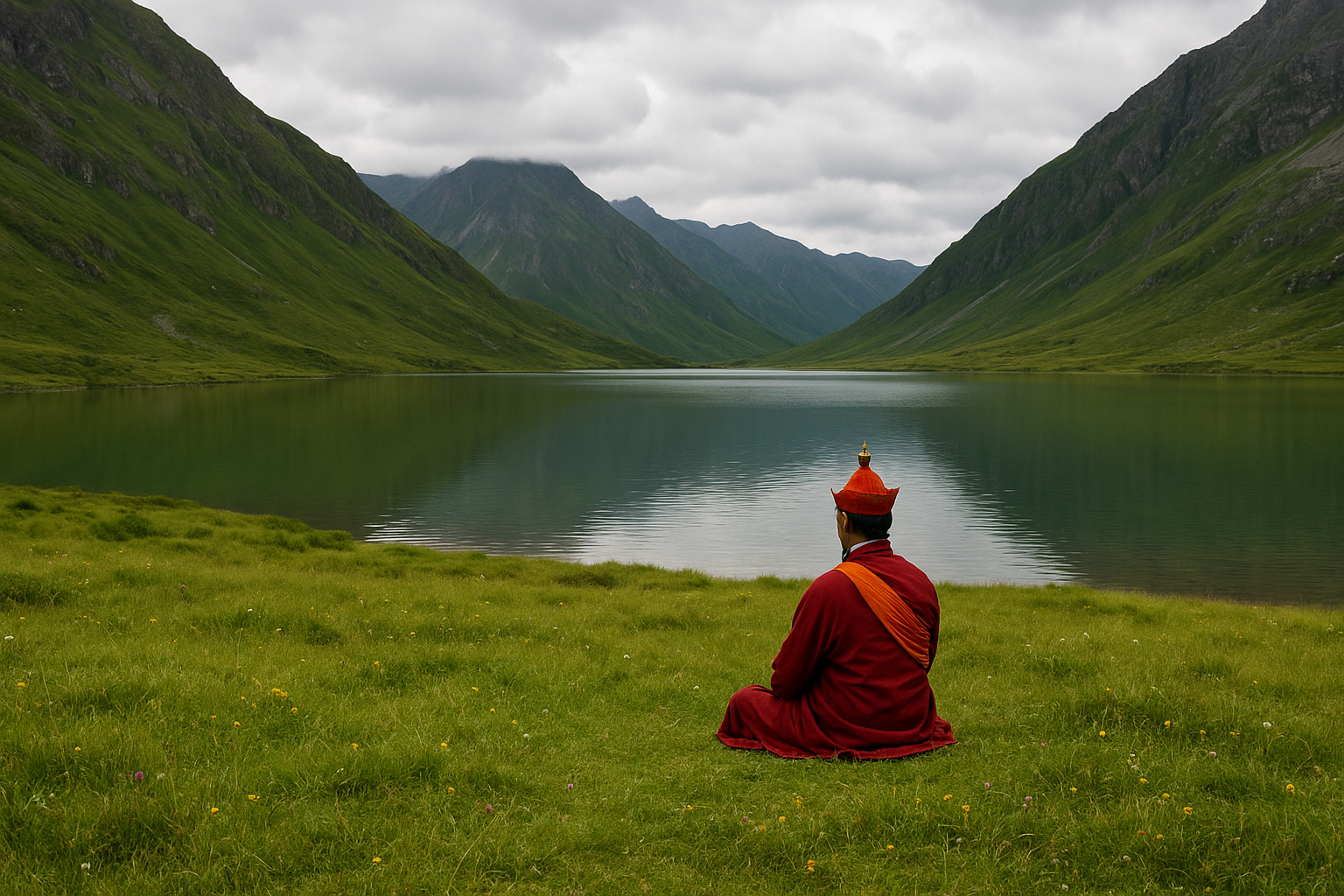
According to the commentator, Jamgon Mipham, A Garland of Views was composed by Padmasambhava in a meadow near the Peacock Lake of Trakmar in Chimpu (near Samye and other monasteries) shortly before he left Tibet during the reign of King Trisong Detsen, based on a text in the Guhyagarbha Tantra. The Guhyagarbha is one of the most important Buddhist tantras. It is a Yoga or Mahayoga Tantra, which was supposed to have been taught by the Buddha to King Indrabhuti of Oddiyana. The oldest surviving lineage of the Guhyagarbha goes back to the late 8th century. The Guhyagarbha Tantra is not one of the first tantras to explicitly teach sexual yoga, but it is among the earliest to symbolically incorporate the sacred union motif that later becomes central to such practices. The full development of physical sexual yoga is seen in later Anuttarayoga tantras, starting in the late 8th century. Similarly, we find Siddhartha Gautama, the historical Buddha, intensely involved in sexual activity prior to his renunciation that led to his ultimate Enlightenment (c. 445 BCE).
Like the Buddha himself in the Brahmajala Sutta, the first sutta of the Suttapitaka of the Pali Canon, Padmasambhava begins A Garland of Views by identifying four “false views entertained by beings in the world,” viz., lack of reflection, materialism, nihilism, and eternalism, the latter two being regarded as opposite variations of extremism. The unreflective have no clear view and are confused. Materialists have no views concerning rebirth and are solely preoccupied with material advantage based on science. Nihilists disbelieve in moral causality. They think that phenomena just appear and disappear. Eternalists believe in self-identity, and are characterized by three views: that reality exists as a causeless effect, a wrong view of causality (that Padmasambhava does not further elaborate), and that unreal or illusory effects proceed from a real cause. According to Padmasambhava, all of these views are based in ignorance.
In contrast to the foregoing, there is the path that leads beyond the world, consisting of two vehicles: the vehicle of the characteristics of phenomena, affliction, and purity, a.k.a. as the causal vehicle, which comprise the Basic Vehicle (Hinayana) and the Great Vehicle (Mahayana), and the Diamond Vehicle (Vajrayana, or Tantra, a.k.a. Secret Mantrayana). The vehicle of characteristics is further divided into the vehicle of disciples, the vehicle of “solitary realizers,” and the bodhisattva vehicle. The first two pertain to the Hinayana, and are found in the Pali Canon, the latter in the Mahayana, and are found in the Mahayana sutras although the bodhisattva doctrine itself is also found in the Pali Canon. Disciples reject extremism and meditate on the Four Noble Truths to accomplish the Four Results under the guidance of a teacher, but they believe in the ultimate existence of self-identical particles (atoms?) and instantaneous moments of consciousness. Solitary buddhas also reject the extremist doctrine of self-identity but have partially realized non-self-identity in form. They are driven by past karma into the realization of the ultimate nature of phenomena by means of the doctrine of interconnectedness, the essence of which is emptiness, which begins with ignorance and culminates in suffering.
Bodhisattvas, based on bodhicitta, the altruistic intention to attain Buddhahood for the sake of all beings, characterized by direct insight into the ultimate nature, “self-arisen gnosis, the single essence,” realize that all phenomena are devoid of inherent existence and are mere illusions, and attain unsurpassable enlightenment by means of training in the ten transcendent perfections, proceeding through ten stages or levels. Here we move beyond the Hinayana into the Mahayana. The Vajra or Diamond Vehicle follows, also divided into three: Kriyatantra, Ubhayatantra (or Upa, “above”), and Yogatantra. The view of the Kriyatantra and Ubhayatantra is that there is neither arising nor cessation; they practise “deity yoga,” culminating in pure vision. On this basis the practitioners of the Kriyatantra meditate on the form body of the “divine being,” bringing together the image of the divine being’s body, the implements symbolizing their mind, mantra recitation, and other requisite elements to gain accomplishment.
The practitioners of the Ubhayatantra also meditate on the form body of the “divine being”, relying on meditative concentration to gain accomplishment. Yogatantra is divided into the outer Yogatantra of austerities and the inner Yogatantra of skilled means. The practitioners of the outer Yogatantra emphasize yoga over the outer requisites, meditating on the male and female energies, concentrating on a perfectly pure mind and meditating, sealed with the four gestures on the form body of the sublime “divine being” to gain accomplishment. The inner Yogatantra is divided into the methods of generation, perfection, and the Great Perfection. These constitute the three highest vehicles of the ninefold system, also known as Mahayoga, Anuyoga, and Atiyoga (or Dzogchen), corresponding to generation of the “divine being” or skilled means, wisdom, and the non-dual union of skilled means and wisdom, respectively.
In the method of generation, concentration is gradually developed and the mandala constructed step by step, training the mind to the level of Universal Light, by meditating on the non-conceptual concentration of “thusness” or “suchness,” resulting in accomplishment. In the method of perfection, one clearly visualizes the form body of the Sublime “divine being”, meditating on everything as the same yet distinct, gaining accomplishment. In the method of the Great Perfection, one meditates on the fact that all phenomena, mundane and supermundane, are the same as the mandala of the enlightened body, speech, and mind of the Buddha. Existence and emancipation are primordial, yet they appear as illusions, which nevertheless have the nature of emancipation, one with perfect, manifest Buddhahood. This is primordial and is not accomplished by the practice of the path. Thus, all phenomena are inseparable from one’s own mind. Padmasambhava quotes the Tantra, “All phenomena abide within the mind. the mind abides in space. And space itself has no abode,” and
All phenomena are by their nature empty.
All phenomena are primordially perfectly pure.
All phenomena are completely radiant.
All phenomena are, by nature, nirvana.
All phenomena are the perfect, manifest state of enlightenment.
This realization marks the transition from Hinayana, based on the truth of suffering, to the Mahayana, in which suffering itself is realized to be illusory.
Conviction (or trust), presumably through devotion or faith, is gained by means of four realizations or understandings: that there is one single cause, by using the seed syllable (mantrayoga), blessing or consecration, and direct realization (gnosis). The realization that there is a single cause is the realization that all phenomena are ultimately unborn and undifferentiated, whereas they are all relatively illusory, like the moon reflected in water. The realization by means of syllables is symbolized by the threefold mantra (AUM), representing enlightened body, speech, and mind respectively, in which A is the unborn nature of phenomena, U its illusory display, and M, the awareness that realizes this illusory gnosis, “without centre or circumference.” The realization of blessing is the realization that all phenomena may be blessed as enlightened by means of the two previous realizations. Direct realization through perception is the conviction gained in the very depths of one’s own mind, through one’s own awareness, that phenomena abide primordially in the enlightened state. This is the path of yoga, and its realization is not a matter of cause and effect (karma). Therefore, it is timeless, instantaneous, and spontaneous.
The lower vehicles exist because disciples do not understand that all phenomena are primordially the enlightened state. Each step prepares the aspirant for the ultimate realization according to their ability based on moral causality, like the steps of a ladder. In the Pali Canon, the historical Buddha referred to the short lives of ordinary human beings and their brutish immersion in existence, their eyes, vision, or understanding covered with “dust,” and even hesitated to teach, implying that there was much more than what he did eventually teach. Padmasambhava says, “‘It’s all a pack of lies,’ they say, belittling superior beings and giving rise to an attitude of repudiation. This is why this teaching is extremely secret and also why it is called the Secret Vehicle,” to be practised only by superior people. In particular, Padmasambhava says that austerities, such as bodily self-mortification, are mistaken, reiterating the historical Buddha’s rejection of this form of asceticism. Therefore it follows that one should purify and perfect one’s view.
As a deep study of the Pali Canon also makes clear, and as I have emphasized many times in these talks, the cultivation of wisdom itself is the essential salvific factor, culminating in non-dual gnosis. This is the fundamental principle of the Perfection of Wisdom (Prajnaparamita). This is the simplest imaginable teaching, reminiscent of Laozi, but precisely because of its simplicity it is also the most difficult to realize. Padmasambhava himself spent many years meditating in cemeteries and engaged in other practices before he realized Enlightenment; it is not a matter of “imagining” one is enlightened, as some modern pseudo-gurus today teach. One can see why Padmasambhava’s doctrine was not welcome in late 8th century Tibet, in the wake of the Great Debate, in which the Indian gradualist schools emerged as the dominant ideology in opposition to Chinese subitism, the doctrine of sudden enlightenment.
Highlights
- Padmasambhava is regarded as “emanation” of the historical Buddha.
- A Garland of Views is attributed to Padmasambhava himself.
- The text is divided into two parts, consisting of different views and various kinds of yogic disciplines.
- The basis of A Garland of Views is the Guhyagarbha, which was received by Garab Dorje from Kukaraja, who in turn transmitted it to Padmasambhava.
- The four ignorant or wrong views are lack of reflection, materialism, nihilism, and eternalism.
- Padmasambhava divides the Buddhist teachings into three sets of three vehicles, each one progressively more profound in an ascending hierarchy, including two Hinayana, one Mahayana, three outer mantra, characterized by “deity yoga,” and three inner mantra vehicles.
- Two paths lead beyond existence, the path of characteristics so-called because it is based on the notion of moral causality (karma), and the Diamond vehicle or Vajrayana.
- Each vehicle is divided into View, Meditation, Result, and Practice.
- The path consists in the progressive purification and perfection of one’s view, culminating in ultimate realization (non-dual gnosis).
- The three highest vehicles are generation, perfection (or completion), and the great perfection.
- Only the highest vehicle communicates the ultimate and essential truth of Buddhism, that all phenomena, mundane and supermundane, are the same as the mandala (“universe”) of the enlightened body, speech, and mind of the Buddha, which is the essential nature of one’s own mind. This realization is instantaneous (subtilism), whereas the realizations of the lower vehicles are gradual. Thus, Padmasambhava reconciles the doctrines of gradualism and subitism.
- Padmasambhava spent many years meditating in cemeteries and engaging in other practices, including shamanic or occult practices, in order to realize ultimate enlightenment.
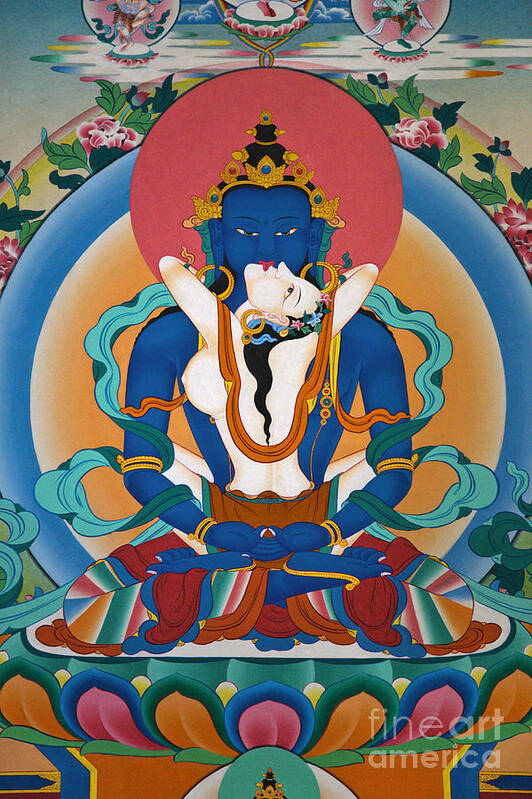
- Padmasambhava himself used sexual yoga to attain enlightenment in a cave in Nepal prior to arriving in Tibet and is practised by the tertons that succeeded him, right up to the present day.
PART III – Philosophical Section, 2
A Noble Noose of Methods and the Mahayoga
A Noble Noose of Methods: The Lotus Garland Synopsis is a Mahayoga Tantra of the tenth century, which may also be attributed to Padmasambhava. The word “noble” refers to accomplishment in a single lifetime. “Noose” refers to the non-abandonment of existence. “Methods” refers to liberation of evil beings through great compassionate action. The “lotus” symbolizes wisdom and “garland” symbolizes method (or skilled means). “Synopsis” indicates that it represents a summary of all key scriptural sources.
Unfortunately, I have not been able to find an English translation of this work. However, I have found a Tibetan edition of the text with extensive scholarly apparatus in English. My remarks that follow are based on this scholarly apparatus. As in A Garland of Views, we find in the Noble Noose of Methods the doctrine of “the sameness of all dharmas,” “ultimately equally unborn and unceasing” (op. cit., p. 88) and “the primordial purity of all phenomena,” which is one of the essential distinguishing doctrines of the Great Perfection (Dzogchen) (op. cit., pp. 4, 87). The Tantra is characterized by a mystical and esoteric interpretation of Tantric ritual which recalls the historical Buddha’s insistence that rituals have no intrinsic efficacy. For example, the Buddha is identified as the quality of innate mental awareness rather than with an historical individual, and empowerment through one’s own natural awareness supersedes ritual. Thus, apparently mundane references are reinterpreted in transcendental terms and ritual is referred to as transformative and powerful in the pursuit of enlightenment (op. cit., p. 5): “enlightenment is to be found by looking into one’s own mind” (op. cit., p. 89). Padmasambhava is also referred to as a realized being associated with the highest level of the Mahayoga transmission, and is regarded as the most advanced spiritual master in the world (op. cit., p. 11f).
The aforementioned scholarly apparatus includes a sixteen-page synopsis of the 42 chapters of the Noble Noose of Methods, beginning with Chapter 1, the Two Truths.
Synopsis of the 42 Chapters of the Noble Noose of Methods
Broadly, the Noble Noose of Methods may be divided the following twelve moments: (1) the two truths doctrine, (2) the vows or precepts, (3) esoteric transmission or empowerment, (4) offering, (5) five chapters on the mandala, (6) two chapters on accomplishments, (7) four chapters on mantras, (8) two chapters on gestures, (9) two chapters on the female demons, (10) fifteen chapters on ritual, especially the homa ritual, (11) four chapters on the ritual knife, (12) four chapters on the Tantric figures made of flour and butter, and a conclusion. Rather than attempt to summarize these chapters in detail, I am going to conclude this section with a broad summary of these categories as a basis for a future talk in which I propose to delve further into this extraordinary text. I am also contemplating another supplementary talk on the Nine Yana system in which I will work out the 36 (4 × 9) elements of this system in detail based on The Garland of Views.
The Two Truths Doctrine (Chap. 1)
The Two Truths doctrine makes a distinction between conventional (or provisional) truth, which describes the phenomenal or contingent world of existence, and ultimate truth, which describes the ultimate reality of emptiness, devoid of concrete or inherent characteristics. Conventional truth is a veil or screen of appearances, identified with ignorance, which obscures the true nature of reality. It is dual, divided into knower and known, or experiencer and experienced, and objects which are ultimately devoid of self-identity. Ultimate truth is free of the subject-object duality. The Pali Canon distinguishes between direct and indirect meanings, or conventional and ultimate (or higher) meanings, in the discourses, the latter of which requires further explanation.
According to Nagarjuna (c 150–c 250), the two truths are epistemological. The existence of the phenomenal world is provisional, neither real nor unreal. Ultimately phenomena are empty of inherent essence or existence, but are interconnected. This is the basis of the Madhyamaka view. In Chinese Buddhism the two truths are ontological. Reality is relative and absolute. There is an essential truth above emptiness and the two truths which is identical with Buddha nature. According to the emptiness doctrine, no metaphysical system is absolutely valid. In Tibetan Buddhism, according to Mipham, meditation on the union of the two truths leads to the arising of primordial wisdom. Thus, one eventually actualizes that which surpasses intellectual knowledge (gnosis). This leads to the doctrine of the indivisibility of the two truths. The doctrine of the two truths ultimately resolves the lived experience of non-duality and non-differentiation.
Samaya (Chap. 2)
Samaya refers to a set of vows or precepts given to an initiate in an esoteric Vajrayana Buddhist order as part of the empowerment or initiation ceremony that creates the bond between teacher and disciple. The term includes a particular system of teachings or doctrines, the conduct required of a tantric practitioner, the realization of Buddhahood, and union with the body, speech, and mind of the Buddha. Sakya Pandita, the 12th century Tibetan Buddhist scholar, identifies fourteen points that may not be violated that are widely followed in Tibetan Buddhism:
- Disrespecting the master.
- Transgressing the words of the buddhas.
- Insulting one’s brothers and sisters.
- Abandoning love for sentient beings.
- Abandoning the bodhicitta in aspiration or application.
- Criticizing the teachings of the discourses and tantras.
- Revealing secrets to those who are unworthy.
- Mistreating one’s body.
- Rejecting emptiness.
- Keeping bad company.
- Failing to reflect on emptiness.
- Upsetting those who have faith in the teachings.
- Failing to observe the commitments.
- Denigrating women.
These points suggest the vow of a bodhisattva, which includes paying homage to, praising the virtues of, serving and making offerings to, and rejoicing in the merits and virtues of the buddhas, bodhisattvas, and all sentient beings, upholding the precepts, asking the Buddha to teach, always following the Buddha’s teachings, and serving and benefitting all sentient beings, including transferring the merit from all practices to and for the emancipation of all sentient beings (Avatamsaka Sutra). In the Nyingma lineage the three root vows are body, speech, and mind. These require refraining from evil with respect to each, maintaining “sacred view,” which means to view all beings and all phenomena as primordially pure, and serving the teacher and the order, practising mantra, refraining from divulging the secrets, and always maintaining the view that one’s mind is essentially the true or real body of the Buddha. Although the conventional view is that the vows are easily damaged, Padmasambhava himself says that any action that is undertaken in the sincere spirit of compassion for all sentient beings cannot violate the vows.
Esoteric Transmission (Chap 3)
During esoteric transmission teachings are communicated from the teacher to their disciple during a Vajrayana empowerment ritual in a space containing the mandala of the divine being, recalling my discussion of the meaning of “deity” from the previous talk. Many techniques are regarded as “secret,” and are communicated using a symbolic code known as “the twilight language.” This language requires the interpretation and guidance of a teacher. Some teachings are regarded as “self-secret” in the sense that they could not be understood even if they were directly revealed to a person.
The empowerment ritual, hearing the text, and oral instruction on how to conduct the practice are traditionally required before one may begin tantric practice. Mipham says that empowerment produces the view of mantra in one’s being as the basis for practicing Vajrayana: “the profound empowerment ritual produces a sudden manifestation of the ground mandala that dwells primordially within oneself.” Kongtrul says that empowerment “ripens the student’s mind by planting the special seeds of the resultant four dimensions of awakening in the aggregates, elements, and sense fields of the recipient.” The mandala is made of flowers, coloured powders, grains, paint, or is visualized. In the Dzogchen tradition, direct introduction is called the Empowerment of Awareness, in which the student is introduced to the intrinsic nature of their mind-essence. The pointing out instruction, also referred to as “pointing out the nature of mind,” “pointing out transmission,” or “introduction to the nature of mind,” introduces the disciple to the nature of mind.
Offering (Chap. 4)
In Buddhism, symbolic offerings are made to the Three Jewels, including candles, lamps, incense, flowers, food, fruit, water, drinks, etc. The objects themselves are not regarded as intrinsically efficacious, but rather the attitude with which they are offered produces merit, which leads to a better rebirth and progress towards the ultimate goal of liberation and enlightenment. These offerings can also function as a preparation for meditation. Some traditions distinguish between material or hospitality offerings and practice offerings.
Material offerings are external offerings of words and deeds, often symbolic in character. In Northern Buddhism sacred images have water, scarves, flowers, incense, lamps, perfume, and food laid before them, representing purification, friendship, and devotion. Non-material or practice offerings are internal offerings for mental development, including giving, moral action, meditation, and wisdom. In the Pali Canon, the Buddha says that practice offerings are “the best way of honouring the Buddha” and “the supreme offering.”
The Mandala (Chaps. 5, 6, 7, 12, 41)
A mandala (lit. “circle”) is a geometric symbolic structure. Mandalas focus attention, facilitate spiritual guidance, define sacred space, and aid meditation and inducing trance. It may be used a map representing divine beings, paradises, or shrines. It describes the spiritual journey in stages from the circumference to the centre. In Vajrayana Buddhism mandalas have also developed into sand panting.
The mandala visually represents the essential Vajrayana teachings. It represents the nature of the Pure Land and enlightened mind as a microcosm representing a divine cosmology or various aspects of enlightenment. Tantric Buddhists meditate on the mandala until it can be visualized in detail, becoming fully internalized. Every mandala is accompanied by a tantric liturgy, including instructions on how to construct and visualize the mandala and the accompanying mantras which empower the mantra. The visualization of pure lands enables one to realize the essential purity of experience itself as the abode of enlightenment.
Sand mandalas are typically brushed together into a pile as a meditation on impermanence and poured into a body of running water to spread its blessings. A mandala offering offers the entire universe to the buddhas and/or one’s teacher. One hundred thousand mandala offerings are part of the preliminary requirement to engage in tantric practice. Mandalas are also described in Pali Buddhist texts, including the Mandala of Eight Disciples, the Mandala of Buddhas, and the Mandala of Eight Devis. In Shingon Buddhism, a blindfolded initiate tosses a flower into a mandala to identify their personal divine being. Mandalas also appear in Mesoamerican civilization and in Christianity, as well as in the psychology of Carl Gustav Jung.
The Siddhis (Chaps. 8, 40)
Siddhis (lit. “knowledge, accomplishment, attainment, success”) are psychic abilities resulting from ego-transcending practices such as meditation and yoga, traditionally said to include clairvoyance, levitation, bilocation, becoming as small as an atom, materialization, and past life recall, although any extraordinary abilities resulting from yoga practices may be described as siddhis. Claims of siddhis are found throughout the Pali Canon and the Buddha appears to have accepted their reality, but discouraged practitioners from making their cultivation their primary goal. Dipa Ma (1911–1989), a prominent Theravadin meditation teacher, was said to exhibit such abilities, which are believed to result from the mastery of meditative concentration. Patanjali says that “accomplishments may be attained through birth, the use of herbs, incantations, self-discipline or samadhi.”
Mantra (Chaps. 9, 11, 14, 15)
A mantra (from. Sanskrit man, “to think,” hence structured formulae of thoughts) is a sacred formula or sound with a specific resonant structure which is believed to be inherently spiritually efficacious (possessing power or “shakti”). Some mantras can be translated, others not. The earliest mantras were composed in Vedic Sanskrit in India, before 1000 BCE, but there are also mantras in Pali, Chinese, Japanese, and Tibetan. For example, OM or AUM is believed to be the original cosmic sound. Other, more complex mantras express spiritual meanings pertaining to truth, reality, light, timelessness, peace, love, knowledge, and action.
Mantras may be melodic, uplifting, and meaningful. Mantras are found in Hinduism, Buddhism, Jainism, Sikhism, Taoism, and Bon, and play a significant role in Tantra. The name of the Japanese Shingon sect means “mantra” (lit. “true speech”). Mantras connote the teaching, truth, reality, and inherent fulfillment. Mantras may also be used as spells or spiritual weapons, and thus have a magical quality. Mantras may be meditated on, recited, muttered, or sung, and are believed to aid meditative concentration.
Mantras are referred to in the Pali Canon and are found in the earliest forms of Buddhism, including Theravada, such as the repetition of “Buddho,” used in the Thai Forest Tradition. Some mantras are used to develop loving kindness. Some mantras take the form of simple affirmations. Mantra practice is often combined with breathing techniques, and is especially popular among lay people. Mantras calm the mind or express spiritual insights. Tantric Theravada, a.k.a. Southern Esoteric Buddhism, which is the oldest living Theravadin tradition, recite Namo Buddhaya (“Homage to the Buddha”), Araham (“Worthy One”), and may be combined with the use of amulets. In China mantras are used for protection or purification. Specific mantras are often associated with particular buddhas, bodhisattvas, or deities.
In Japan Kukai (774–835), a noted Buddhist monk, developed a theory of language in which every syllable of a Buddhist chant, mnemonic code, incantation, or recitation, was a manifestation of the true nature or ultimate reality, and that all sounds manifest emptiness of self-nature. According to Kukai, all sounds originate from A (cf. AUM), associated with emptiness. In Sanskrit A is a prefix which changes the meaning of a word into its opposite, similar to English. The Mahavairocana Sutra, central to Shingon, says, “Thanks to the original vows of the Buddhas and Bodhisattvas, a miraculous force resides in the mantras, so that by pronouncing them one acquires merit without limits.” The original name of the Nyingma school of Tibetan Buddhism, founded by Padmasambhava, was Mantrayana, which became a synonym for Vajrayana.
According to Edward Conze, the use of mantras passed through three historical stages. In the first stage, mantras were associated with the pan-Indian doctrine of the Power of Truth, also found in the Pali Canon. In the second stage (1st cent–13th cent.), mantras were associated with spirituality. In the third stage (7th cent. on) mantras became associated with salvific empowerment, and were combined with gestures and visualizations.
The most famous Buddhist mantra is OM MANI PADME HUM, the six-syllable mantra of Avalokiteshvara, the bodhisattva of compassion, which literally means “OM the Jewel in the Lotus HUM.” OM, I have already explained; HUM represents the spirit of enlightenment or wisdom.
Mudra (Chaps. 10, 16)
Mudra (lit. “seal, mark, gesture”) is a Hindu, Jain, or Buddhist ritual gesture or pose. Gestures may involve the entire body or just hand gestures. Gestures are significant in Indian religion, dance, and yoga. In hatha yoga, gestures are used together with breath control, usually while seated, to affect the breathing and direct the flow of vital energy. It is also associated with seminal energy; the thought of enlightenment; the nectar of timelessness; and consciousness.
Buddha images are commonly shown in various postures and mudras, often representing various moments in the life of the Buddha, including
- the gesture of fearlessness,
- earth witness,
- fist of wisdom,
- turning of the wheel,
- meditation gesture, a.k.a. samadhi or yoga mudra,
- generosity gesture,
- thunder gesture,
- gesture of discussion or explanation,
- gesture of wisdom, which has been dated to 700 BCE, and
- karana or tarjani mudra, similar to the Western “sign of the horns,” which is believed to repel negative energy.
The Indian dance form known as Kathakali involves as many as nine hundred gestures, including the hands, arms, and body and facial expressions.
The Hathayogapradipika emphasizes the importance of gestures, stating that “the [Kundalini] goddess sleeping at the entrance of Brahma’s door [at the base of the spine] should be constantly aroused with all effort, by performing mudra thoroughly.” The kechari mudra, in which the tongue is turned back “into the hollow of the skull,” seals in the seminal fluid so that it stops dripping down from the head, and is not lost, similar to a gesture attributed to the Buddha in the Pali Canon, where the Buddha recommends pressing the tongue against the roof of the mouth. In the famous vajroli mudra, the seminal energy is retained or reabsorbed.
Some Asian martial arts also utilize gestures. Tendai and Shingon Buddhism derived similar gestures from Mikkyo (“esoteric”) Buddhism, which are considered to be not only spiritually but physically powerful.
The Rakshasis (13, 15)
Rakshasis are female cannibalistic beings described in Hinduism, Buddhism, and Jainism, also referred to as “man-eaters,” rakshasa being the male form. This term is also used to describe anti-gods, power-mongering divine beings that are conventionally regarded as anti-spiritual. They are often described as anti-Buddhist, although according to the Pali Canon some anti-gods at least respected the Buddha. In chapter 26 of the Lotus Sutra a group of rakshasa daughters swear to uphold and protect the Lotus Sutra. They also teach sacred chants which protect those who uphold the discourse.
According to the Lankavatara Sutra, Sri Lanka is identified as the land of the rakshasas, whose king, Ravana, invites the Buddha to Sri Lanka to teach. Rakshasa is also a nickname ascribed to Padmasambhava for his wrathful conquest of Buddhist heretics.
The rakshasis appear in chapters 13 and 15 of the Noble Noose of Methods, in which the wrathful female mandala deities are absorbed into the body in accordance with the primary doctrines of the sameness and primordial purity of all phenomena, previously discussed. In psychological terms, negative psychic energy is consciously assimilated in order to avoid creating a negative compensation such as one sees in exoteric and dualistic religiosity.
Homa (Ritual) (Chaps. 17, 18, 19, 22, 23, 24, 25, 28, 29, 30, 33, 34, 35, 38, 39)
A Noble Noose of Methods devotes no less than fifteen chapters to various kinds of ritual. For the purpose of this introductory overview, I am going to focus on the homa ritual, and leave a detailed consideration of the rest for a future more in-depth talk on the specific chapters.
Homa (lit. “pouring into fire, offer, sacrifice”) is an ancient Vedic fire ritual performed by a priest for a householder on special occasions, such as weddings, in which grains, ghee, milk, incense, and seeds are offered to the fire. In Shingon temples it is performed daily. It expresses a reverence for fire and cooked food, and is believed to be productive of merit, with various spiritual interpretations, and is also related to soma, the reputed drink of the gods which confers timelessness. The symbolic interpretation of the rite is especially important in Buddhism, since the Buddha specifically denied the intrinsic efficacy of ritual: e.g., fire and water represent male and female energies or vertical and horizontal polarities of existence, the square mandala represents the earth or the cosmos, etc. The homa ritual is found in ancient Buddhism and Jainism, and spread to central, east, and southeast Asia, especially Tibet, China, and Japan. Its earliest forms go back to the Brahmanas (900–600 BCE). The Mahayana appropriation of the homa is based on the belief, alluded to in the Pali Canon, that the Buddha was restoring the true spiritual interpretation of the primordial religion of the Vedas. Its Buddhist forms include invoking Buddhist divine beings, making offerings to the fire, reciting mantras, clapping, reciting hymns, beating drums, blowing conch shells, and a central mandala.
In addition to the homa, other ritual actions described in the Noble Noose of Methods include the destructive ritual, the ritual union, conferring transference of abode, the captivation ritual, the increasing ritual, and the pacifying ritual.
Phurba (Chaps. 20, 26, 31, 36)
Tibetan phurba (Skt. kila, kilaka, or kilaya, “nail”) is a nail-like ritual implement, peg, stake, or knife, having three sides, associated with Indo-Tibetan Buddhism, Bon, and Indian Vedic traditions, and used by shamans, magicians, tantrikas, and lamas. The phurba is a manifestation of the apparent body of the meditational divine beings Vajrakila or Vajrakilaya (Tib. Dorje Phurba), a wrathful Wisdom King who embodies the enlightened activity of all the Buddhas, who removes obstacles and destroys antagonistic forces. Phurbas generally have a pommel, handle, and blade, often segmented into threes on vertical and horizontal axes, highlighting the numerological significance and spiritual significance of the numbers 3 and 9. They may be made of wood, metal, clay, bone, gems, horn, or crystal. Phurbas are often made of brass or iron, especially terrestrial or meteoric iron and tektites, gravel-sized bodies of black, green, brown, or grey natural glass formed from terrestrial debris ejected during meteorite impacts. Meteoric iron was highly prized throughout the Himalayas and was incorporated into five-metal alloys of sacred significance used for ritual implements. The pommel often bears three faces of Vajrakila, joyful, peaceful, and wrathful, or an umbrella, mushroom cap, meditation divine being, snow lion, stupa, etc. The handle often features a “diamond-thunderbolt,” weaving, or knot work design, generally of a triune form. The blade is generally composed of three triangular facets or faces, meeting at the tip, representing the blade’s power to transform the three poisons or root poisons of attachment/craving/desire, delusion/ignorance/misconception, and aversion/fear/hate.
One of the main methods to actualize the essence/quality of the phurba is to pierce the earth with it, sheath it, or to plunge it into a container of rice. The phurba may be regarded as an axis mundi or world tree, symbolically connecting heaven and earth. The phurba stabilizes a prayer ground during ceremonies. Its energy is fierce, wrathful, piercing, affixing, transfixing. It spatializes the earth, establishing an energetic continuum. Wooden phurbas may be used for shamanic healing, harmonizing, and energy work, and often have two snakes, serpents, or dragons entwined on the blade. Phurbas often bear one or more of the eight auspicious signs, i.e., parasol, golden fish, conch, vase, lotus, knot, banner, and wheel or a swastika.
The phurba may be used for curing disease, exorcism, killing demons, meditation, consecration, and even weather-making. The blade destroys demonic forces. The top of the phurba is used for blessings. Robert Beer says,
The sting of the scorpion’s whip-like tail transfixes and poisons its prey, and in this respect it is identified with the wrathful activity of the ritual dagger or kīla. Padmasambhava’s biography relates how he received the siddhi of the kīla transmission at the great charnel ground of Rajgriha from a gigantic scorpion with nine heads, eighteen pincers and twenty-seven eyes. This scorpion reveals the kīla texts from a triangular stone box hidden beneath a rock in the cemetery. As Padmasambhava reads this terma text spontaneous understanding arises, and the heads, pincers, and eyes of the scorpion are ‘revealed’ as different vehicles or yanas of spiritual attainment. Here, at Rajgriha, Padmasambhava is given the title of ‘the scorpion guru’, and in one of his eight forms as Guru Dragpo or Pema Drago (‘wrathful lotus’), he is depicted with a scorpion in his left hand. As an emblem of the wrathful kīla transmission the image of the scorpion took on a strong symbolic meaning in the early development of the Nyingma or ‘ancient school’ of Tibetan Buddhism.
Note that Padmasambhava himself is here described as reading a treasure text, indicating that the concept of the treasure text is not original or restricted to Padmasambhava’s successors.
Phurbas are cognate with prayer flags and stone pillars in that they pierce the land, comparable to the idea of breaking the earth, turning the sod, or laying a foundation stone, sanctifying the ground that lies beneath, placating the spirits of place and preparing the land as a rite to ensure fertility and a bountiful yield.
Torma (Chap. 21, 27, 32, 37)
Tormas (lit. “to cast away, break up, scatter”) are butter and flour figures used in Tantric Buddhist rituals or used as offerings. They may be dyed in assorted colours. Often the main body of the torma, usually conical, is red or white. Typically they are small and placed on a shrine, plate, mounted on leather, or sit on a special base such as a skull. Tormas follow the pre-Tibetan Buddhist tradition of offering cakes. The term implies offering, letting go, or detachment. Sometimes tormas are placed on shrines for ceremonies or to represent divine beings. Others are used for feast practice and are consumed by celebrants. Others appease spirits, accumulate merit, or remove obstacles. Mostly they are made of barley flour and butter, as well as egg, milk, sugar, honey, and even meat. In addition to divine being, food, and offering tormas, medicinal tormas may be used shamanically to extract disease from a patient. Captured tormas may be used to expedite completion of activities, by planning to offer the torma when an activity is completed. Inner, secret, and very secret tormas involve meditation with visualization as a form of torma offering although no physical cake is involved. Thus, one may offer one’s psychological experiences such as an experience of “suchness” as non-physical torma offerings. This last category suggests that tormas may actually be regarded as physical projections of psychological experiences, as suggested by Jung. Similarly, the Tantras recognize divine beings as psychological archetypes, as previously mentioned.
Appendix
In his Teachings of Padmasambhava Herbert Guenther also identifies five terma texts that he attributes to Padmasabhava, viz,
- sPros-gcod rtsa-ba (The Essence of Cutting through Complexity)
- bCud-kyi yang-snying (The Essence of Life or the Living Heart)
- bDud-rtsi bcud-thigs (The Nectar Drop or the Ambrosial Essence)
- sNang-gsal spu-gri (The Razor-Like Clarity or the Illumination as Sharp as a Razor)
- sNang-srid kha-sbyor[28] (The Non-dual Nature of Appearances or the Non-duality of Phenomena)
As far as I know, none of these have been translated into English (other than Guenther’s own selected quotations in Teachings).
Chronology
Note: Dates vary widely and are not necessarily mutually consistent. The below is just a sampling of possible dates based on some reputable sources.
100 BCE. Approximate date of earliest Prajnaparamita texts.
ca. 35, 25 or 29-17 BCE. Date of writing down of the Pali Canon. Other authorities say early first century BCE.
c 665. Wikipedia’s date for Garab Dorje. Encyclopedia of Buddhism says he flourished c. 55 (other dates range from 184 to 57 BCE), which are all too early for him to have been in contact with Padmasambhava. Okar Research says he was born close to Lake Kutra in the region of Dhanakosha and lived in the 7th century.
717. Birth year of Padmasambhava, according to Google.
725. Birth of Santarashita. Madhyamaka philosopher who founded Samye monastery (Princeton Dictionary of Buddhism).
732. Birth of Padmasambhava in a village near the present day town of Chakdara in Lower Dir District (Okar Research)
742. Herbert Guenther’s date for beginning of the reign of King Trisong Detsen.
745. Padmasabhava “flees” Oddiyana in the direction of Kashmir, where he remains until 752 (Okar Research).
749. Padmasambhava’s arrival in Tibet (Government of Sikkim website).
750. Election of Gaupala as emperor of Gauda.
754. Beginning of reign of King Trisong Detsen (Princeton Dictionary of Buddhism).
755. Beginning of reign of King Trisong Detsen.
756. Enthronement of King Trisong Detsen (Dunhuang Annals).
757. Birth of Yeshe Tsogyal (Okar Research, Princeton Dictionary of Buddhism)).
763. Possible start date for construction of Samye monastery.
771. Herbert Guenther’s date for Trisong Detsen’s edict setting up Buddhism as the state religion of Tibet.
774. Herbert Guenther’s approximate date for end of reign of King Trisong Detsen and Padmasambhava’s departure from Tibet. Also cited by Okar Research, who says he was “chased out of Tibet.” See also 779 and 786.
c 775. Founding of Samye monastery (Princeton Dictionary of Buddhism).
777. Approximate beginning of reign of Dharmapala.
779. Completion date for construction of Samye monastery. Possible approximate date for entry of Padmasambhava into Tibet.
786. Okar Research’s date for Padmasambhava’s entry into Tibet.
788. Death of Śāntarakṣita (Princeton Dictionary of Buddhism).
792. Beginning of the Great Debate.
794. End of the Great Debate.
797. Possible date for the end of King Trisong Detsen’s reign. Approximate date of the Great Debate (Princeton Encyclopdia of Buddhism).
799. End of reign of King Trisong Detsen (Princeton Dictionary of Buddhism).
c 800. Alternative date for the end of Trisong Detsen’s reign.
803. Padmasambhava’s departure from Tibet (Government of Sikkim website).
804. Alternative date for the end of King Trisong Detsen’s reign. Latest probable date for departure of Padmasambhava from Tibet.
816. Approximate end of reign of Dharmapala and beginning of reign of Devapala.
817. Death of Yeshe Tsogyal, consort of Padmasambhava (Okar Research, Princeton Dictionary of Buddhism).
842. Beginning of “era of fragmentation” prophesied by Padmasambhava.
855. Approximate end of reign of Devapala.
Early 11th century. End of “era of fragmentation.”
1124. Beginning of terma tradition as it pertains to Padmasambhava.
1253. Alternative date for end of “era of fragmentation.”
1575. Birth of Taranatha (Princeton Dictionary of Buddhism).
1611. Taranatha writes Life of Padmasambhava.
1634. Death of Taranatha (Princeton Dictionary of Buddhism).
Bibliography
Achard, Jean-Luc. “The View of Spyi-Ti Yoga.” http://himalaya.socanth.cam.ac.uk/collections/journals/ret/pdf/ret_31_03.pdf.
Alak Zenkar Rinpoche Thubten Yima. “A Brief Presentation of the Nine Vehicles,” https://www.lotsawahouse.org/tibetan-masters/alak-zenkar/nine-yanas.
Beer, Robert. The Encyclopedia of Tibetan Symbols and Motifs. Boston: Shambhala, 1999.
Bharati, Agehananda. The Tantric Tradition. London: Rider—Random Century, 1992.
Bodhi. “Dhamma and Non-duality.” 1998, https://www.accesstoinsight.org/lib/authors/bodhi/bps-essay_27.html.
Cantwell, Cathy, and Robert Mayer. A Noble Noose of Methods, the Lotus Garland Synopsis: A Mahayoga Tantra and Its Commentary, Beitrage zur Kultur—un Geistesgeschlchte Asiens, No. 73. Budapest: Osterreichische Akademie der Wissenshaften Wien, 2012.
Crosby, Kate. Traditional Theravada Meditation and its Modern-Era Suppression. Hong Kong: Buddha Dharma Centre of Hong Kong, 2013.
Dalton, Jacob. “Padmasambhava.” The Treasury of Lives. https://treasuryoflives.org/biographies/view/Padmasambhava/TBRC_P4956.
de Falco, Christiana, trans. A Biography of the Great Master Padmasambhava. Arcidosso, Italy: Shang Shung Institute, 2011.
Dharma Fellowship of His Holiness the Gyalwa Karmapa. “Lord Padmasambhava: Embodiment of All the Buddhas.” http://www.dharmafellowship.org/biographies/historicalsaints/lord-padmasambhava.htm.
Guenther, Herbert. The Teachings of Padmasambhava. Leiden: E.J. Brill, 1996.
———. “What Is That Which Is Called Yoga: A Tibetan Buddhist Perspective.” https://www.beezone.com/what_is_yoga.htm.
Hermawan, Deny, trans. Taranatha’s Life of Padmasambhava. N.p.: self-published, 2017.
Lotsawa House. “Dzogchen Series.” https://www.lotsawahouse.org/topics/dzogchen.
———. “Padmasambhava Prayers.” https://www.lotsawahouse.org/topics/guru-rinpoche-prayers.
Mayer, Rob. “Padmasambhava in Early Tibetan Myth and Ritual.” 2 pts. http://blogs.orient.ox.ac.uk/kila/2011/05/06/padmasambhava-in-early-tibetan-myth-and-ritual-part-1/, http://blogs.orient.ox.ac.uk/kila/2011/05/08/padmasambhava-in-early-tibetan-myth-and-ritual-part-2-ioltibj321.
———, and Cathy Cantwell. Kili Kilaya. https://blogs.orient.ox.ac.uk/kila.
Nanamoli and Bodhi, trans. The Middle Length Discourses of the Buddha: A New Translation of the Majjhima Nikaya. The Teachings of the Buddha. Boston: Wisdom Publication, 1995.
Okar Research. http://okarresearch.weebly.com.
Padmasambhava and Jamgon Mipham. A Garland of Views: A Guide to View, Meditation, and Result in the Nine Vehicles. Trans. Padmakara Translation Group. Boston: Shambhala, 2015.
Shaw, Sarah, trans. Buddhist Meditation: An Anthology of Texts from the Pali Canon. London: Routledge–Taylor & Francis Group, 2006.
Tiso, Francis V. Rainbow Body and Resurrection: Spiritual Attainment, the Dissolution of the Material Body, and the Case of Khenpo A Cho. Berkeley: North Atlantic Books, 2016.
Trungpa, Chögyam. Crazy Wisdom. Dharma Ocean Series. Boulder, CO: Shambhala, 2001.
Dharma Ocean Series. Tuttle, Gray, presenter. “Padmasambhava and History.” Rubin Museum. https://www.youtube.com/watch?v=kRHDF699wCs.
Van Schaik, Sam. “Padmasambhava I: The Early Sources.” Early Tibet. https://earlytibet.com/2007/06/20/padmasambhava.
Wangdu, Pasang, and Hildegard Diemberger. dBa’ bzhed: The Royal Narrative Concerning the Bringing of the Buddha’s Doctrine to Tibet. Wien: Verlag der Österreichischen Akademie der Wissenschaften, 2000.
Wayman, Alex, trans. Yoga of Guhyasamaja Tantra: The Arcane Lore of Forty Verses—A Buddhist Tantra Commentary. Delhi: Motilal Banarsidass, 1977, rpt. 1980.
[1] Catoptromancy, or divination using a mirror, is an ancient practice used to obtain auguries or gain spiritual insights. By this means Padmasambhava was able to identify local spirits that were hostile to Buddhism and neutralize their negative influences.
[2] Also spelled Uddayana, Urgyan, Wuchang, and Urkhin. Lit. “royal garden, orchard.” Some scholars identify it with the Indian state of Odisha.
[3] Sanskrit, Srado in the language of Oddiyana.
[4] The name “Amitabha” is given the usual Sanskrit interpretation of “Infinite Light.” However, Prof. Lokesh Chandra, possibly the foremost expert on Buddhist iconography, states that the name is, in fact, Prakrit and that it means “Light of Amrita.” Thanks to Mike Crowley for this information.
[5] c 29-17 BCE? (Some authorities now date the writing of the Pali Canon to the early 1st century BCE.)
[6] Sic. Properly, zung ‘jug. This is the esoteric process of yuganaddha, which occurs in the cranial cakra called sunyacakra, the cakra of Voidness, equivalent to the Hindu tantric visualization of the union of Siva and Shakti, male and female. See Agehananda Bharati, The Tantric Tradition, pp. 254, 265, 271 n. 29, 277 n. 74, 294. Thanks to Sean Hillman for assistance with identifying the Tibetan orthography.
[7] Cathy Cantwell and Robert Mayer, A Noble Noose of Methods, the Lotus Garland Synopsis, p. 6. Wikipedia refers to the era of fragmentation which extended from 842 to 1253. Thus, Padmasambhava must have left Tibet before 842 at the latest.
[8] The English translation of yidam or ishtadevata, “deity,” is somewhat misleading. A yidam is a manifestation of Buddhahood or enlightened mind. The yogi identifies their own form, attributes, and mind with those of a yidam for the purpose of personal transformation. Tsongkhapa says that deity yoga separates Tantra from sutra practice. Similarly, the Buddha recommends the visualization of devas in the Pali Canon (see Sarah Shaw, Buddhist Meditation, pp. 8, 115f., 127–34).
[9] Viz., form, sensation, perception, mental activity, consciousness.
[10] Very Joyous, Stainless, Light-Maker, Radiant Intellect, Difficult to Master, Manifest, Gone Afar, Immoveable, Good Intelligence, and Cloud of Dharma.
[11] Noble Noose of Methods, p. 89.
[12] Or “O.”
[13] Noble Noose of Methods, p. 91. This implies that such persons can dispense with the lower yanas, and proceed directly to the practice of the Mahayoga.
[14] Noble Noose of Methods, esp. pp. 91–98. Cantell and Mayer also refer to a commentary on another book, The Charnel Ground Cuckoo’s Display (Dur khrod khu byug rol pa), an Anuyoga root sutra, entitled “The Elixir’s Vital Seed,” attributed in the Tenjur to Padmasmabhava (ibid, p. 92). I have not been able to locate an English translation of this text. It is unclear whether Padmasambhava is the author of the Tantra, the commentary, or both, but it is reasonably certain that at the very least they come out of the original tradition associated with him and the Garland of Views, which as I have previously stated is generally accepted as the work of Padmasambhava.
[15] Noble Noose of Methods, p. 68.
[16] Ibid, esp. pp. 1–102.
[17] Otherwise expressed as “the ultimate sameness of the dharmas of samsara and nirvana, and the total purity the defiled dharmas as the enlightened body, speech and mind of the tantric deities (op. cit., p. 87). “All dharmas are empty in their essential nature, … primordially totally pure, entirely clear light, nirvana in nature, primordially the completely perfected buddhahood” (op. cit., p. 89).
[18] 42 is the number of letters in the Sanskrit alphabet, representing 42 stages on the path to enlightenment. Interestingly, it is also the number of the meaning of the life in The Hitchhikers Guide to the Galaxy! It is of course half of 84, a number frequently found in Buddhism, representing totality.
[19] I am indebted to Wikipedia for much of the material that follows.
[20] “Whatever bodhisattvas do, positive or negative, if they are imbued with great compassion, they will not damage their vows” (Garland of Views, p. 25).
[21] Along with taking refuge and prostration, the cultivation of bodhicitta, the recitation of Vajrasattva’s hundred syllable mantra, and guru yoga, held to purify pride, jealousy, hatred, and delusion respectively, the mandala offering itself purifying attachment.
[22] Referring presumably to psychedelics.
[23] Kate Crosby, Traditional Theravada Meditation and its Modern-Era Suppression.
[24] “With his teeth clenched and his tongue pressed against the roof of his mouth, he beats down, constrains, and crushes mind with mind” (Vitakkasanthana Sutta, MN 20.7f., trans. Nanamoli and Bodhi).
[25] E.g., Judaism, Christianity, and Islam, which together represent 54.3% of the human population, all demonizing each other and those who do not follow their particular paths. Lest one doubt the real immorality of the Jewish ideology, and its fundamental unworthiness of being the dominant religion of the world, consider the following themes, including genocide, patriarchy, misogyny, sexism, slavery, speciesism, demonism, human sacrifice, racism, capital punishment, and religious fascism, all of which one finds fully worked out in the Hebrew Bible, which purports to represent the “word of God”:
1. Violence and War
- Divine commands for total war and genocide
- Massacres of civilians, including women and children
- Ritual slaughter of prisoners or conquered peoples
- Holy war waged to seize land or prove faith
- Praise of warriors and divine wrath as virtues
2. Patriarchy and Gender Control
- Women treated as property or spoils of war
- Forced marriages and concubinage
- Bride-price transactions
- Rape treated as a property crime
- Obedience of wives to husbands framed as divine law
- Female silence or exclusion from leadership
- Punishments for adultery skewed toward women
- Ritual impurity attached to menstruation or childbirth
3. Slavery and Servitude
- Regulation and acceptance of slavery
- Permission to beat or brand slaves
- Capture of slaves in war
- Hereditary servitude and foreign enslavement
- New-Testament exhortations to obey masters
4. Religious Violence and Intolerance
- Execution of idolaters, blasphemers, heretics, and witches
- Persecution of rival sects or prophets
- Censorship of doubt and questioning
- Sacred violence justified as zeal for God
5. Human and Animal Sacrifice
- Ritual slaughter of animals in vast numbers
- Firstborn animals and sons consecrated or threatened
- Abraham–Isaac narrative as model of obedience
- Jephthah’s daughter, child sacrifices under kings
- The crucifixion framed as the final human offering
6. Collective and Generational Punishment
- Descendants punished for ancestors’ sins
- Whole nations cursed for one ruler’s disobedience
- Floods, plagues, and famines as divine reprisals
- Original sin: inherited guilt from the first parents
7. Ethnic and Cultural Exclusion
- Chosen-people ideology
- Extermination or subjugation of neighbouring tribes
- Purity laws forbidding intermarriage
- Ritual or genealogical “uncleanness”
- Nationalism sanctified as covenant
8. Supernatural Retribution
- Hell, eternal torment, and apocalypse
- Demonic possession as illness explanation
- Cosmic dualism: good rewarded, evil annihilated
- Fear-based conversion through visions of wrath
9. Property and Economic Harshness
- Divine sanction of conquest and plunder
- Heavy tithes and offerings demanded of the poor
- Prosperity treated as moral virtue
- Debtor slavery and indenture tolerated
10. Body and Purity Control
- Circumcision and ritual mutilation
- Taboo on mixed fabrics, foods, sexual acts
- Isolation of the sick or “unclean”
- Stoning for moral or ritual defilement
11. Moral Paradoxes
- Lies and deceit sanctioned when divinely useful
- Holy men committing acts of cruelty or treachery
- Prophetic curses and magical thinking
- Obedience valued above conscience
12. Apocalyptic and Eschatological Violence
- Cosmic warfare between God and creation
- Destruction of the world as moral victory
- Joy in the annihilation of unbelievers
- Blood imagery as proof of justice fulfilled
The Christian Church has also participated in numerous crimes against humanity, including during the Dark Ages, the Crusades, the Inquisition, the witch hunts, burnings at the stake, torture, the Sack of Constantinople, the persecution of science, colonialism, and the Doctrine of Discovery, which enabled enforced conversion and cultural genocide. The Church was complicit in the encomienda system and enslavement, and was directly involved in Spanish and Portuguese genocides and the resulting death tolls in the Americas. The Black Legend further highlights Church complicity in colonial atrocities, including its role in African slavery and the enslavement of Indigenous peoples. More recently, the Church has faced widespread criticism for its cover-up of sexual abuse scandals, its political power as represented by the Papal States, and its role in facilitating the Holocaust, often through its ambiguous stance during World War II. The Church has also had a longstanding opposition to birth control and women’s rights, and its treatment of LGBTQ+ individuals has been a source of significant criticism.
In Canada, the Church’s role in residential schools and its treatment of Indigenous children—along with the exploitation of unwed mothers and children in Ireland, including the forced labor and abuse of nuns in institutions like the Magdalen Laundries, remains a dark chapter in its history. This includes allegations of infanticide or the abandonment of children born to nuns, often as a result of priestly abuse, in a broader pattern of systemic exploitation and cover-ups. Despite these scandals, the Roman Catholic Church continues to operate public schools and other educational establishments in countries like Canada. We also see the rise of religious fundamentalism in places like Israel, the United States, and elsewhere, with devastating consequences for human rights and social progress. (Thanks to Margaret Atwood, author of The Handmaid’s Tale, for the insight and methodology underlying this note. Professor Jiang Xueqin also recognizes the historical significance of religious eschatology which is playing itself out right now.)
These beliefs are not stuck in the past. We see their consequences being worked out even today in the Middle East. Can there be any doubt that this is the “barbarian dharma” referred to in the Kalachakra? Theravada Buddhism is similar (see Bhikku Bodhi, “Dhamma and Non-duality”). We see the consequences of the latter in Sri Lanka, Myanmar, and Thailand. Marxism and capitalism are also both based in an “us versus them” mentality which is ultimately mutually destructive. All of this is the consequence of metaphysical dualism, which is epistemologically unsatisfactory and actually productive of the very evil it seeks to destroy. The subject-object dichotomy, the original duality, is of course the original and originating condition of samsara, identical with ignorance (avidya), “the Wrong of the Beginning.”
[26] Cf. the Twin Miracle of the Buddha, in which he is supposed to have levitated and emitted fire and water from his body, alternating between them. The reputed miracle is not canonical but is described in a commentary on the Pali Canon. See Sarah Shaw, Buddhist Meditation, p. 97. Of course, one can find symbolic meaning in this story without taking it literally.
[27] The Encyclopedia of Tibetan Symbols and Motifs, pp. 277f.
[28] op. cit., p. 6 n. 13.
 Dharmata
