

Certainly one of the most notorious and unsettling arhants in the Pali Canon is Angulimala, whose name means “finger garland.” According to the received tradition, he was a violent bandit who murdered travellers in the Jalini Forest and wore a necklace made from their fingers before meeting the Buddha, entering the Buddhist order, and attaining emancipation.
The story is so strange that it resists being reduced to a simple moral lesson. It is often told as a tale of redemption: even the worst criminal can be transformed by the Dharma. That interpretation is not wrong. It is plainly one of the meanings the tradition drew from the story. But the text also contains deeper tensions: questions about karma, ordination, truth, violence, social memory, and the possibility that awakening may appear in forms that conventional morality finds almost impossible to recognize.
The question I want to ask is this: can Angulimala legitimately be understood as evidence for some kind of proto-Tantric or antinomian spiritual current in early Buddhism? Or is that merely an anachronistic reading imposed backward from later Vajrayana and mahasiddha traditions?
The answer, I think, must be carefully divided into three levels. First, there is what the text itself supports. Second, there is what may reasonably be inferred from its oddities and internal tensions. Third, there is what remains speculative, however suggestive it may be.
Let us begin with the received story.
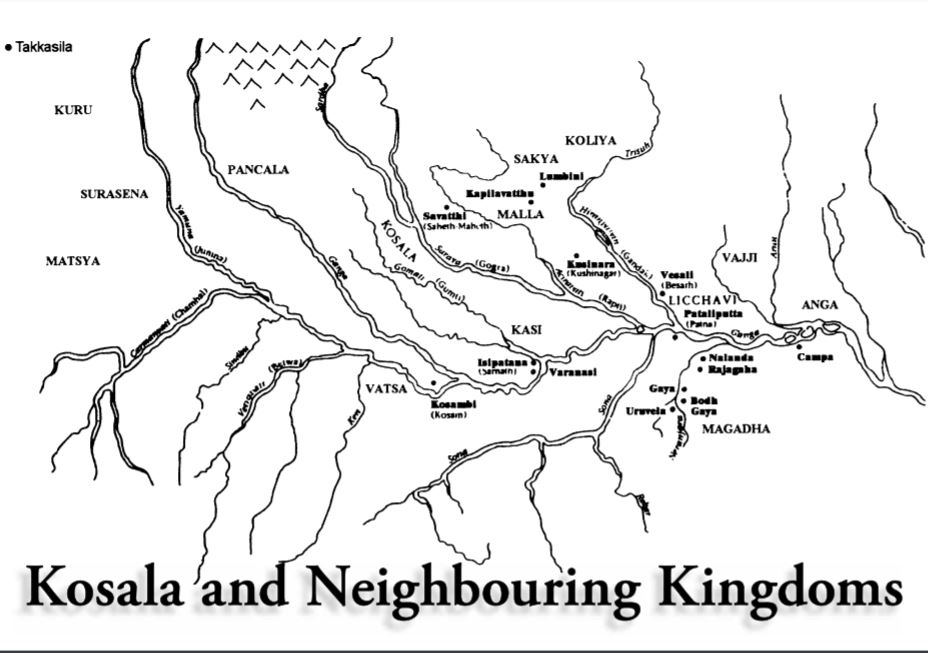
According to the Pali tradition and its commentaries, Angulimala was originally named Ahimsaka, “the harmless one.” He was born into a brahman family. His father, Bhaggava Gagga, was connected with the court of King Pasenadi of Kosala, one of the major states of ancient India. The commentarial story adds that Ahimsaka was born under an ominous constellation associated with robbery and violence. His parents gave him the name Ahimsaka in an attempt to avert this fate.
He was sent to study at Takkasila, one of the great centres of learning in ancient India. There he became the foremost pupil of his teacher. Then, according to the commentary, he became the object of jealousy and slander. Other students accused him of improper conduct, in some versions involving the teacher’s wife. His teacher, enraged or deceived, demanded from him a monstrous final offering: one thousand human fingers. Bound by loyalty to his teacher, Ahimsaka entered the forest and began killing travellers. He became Angulimala, “the finger-garlanded one.”
This explanation is morally and psychologically bizarre. The idea that a brilliant student would become a mass murderer because his teacher demanded fingers as a fee is difficult to accept at face value. One may take it as legend, edifying myth, or the attempt of later tradition to explain something it no longer understood. But even if the commentarial account is legendary, the canonical story remains striking enough.
In the Angulimala Sutta, the Buddha deliberately goes to meet Angulimala despite being warned by local people that the road is dangerous. This is important. The Buddha is not accidentally intercepted by a bandit. He chooses to enter the domain of a terrifying outsider.
Angulimala follows the Buddha and tells him to stop. The Buddha replies, “I have stopped, Angulimala. You too stop.” This is the turning point of the discourse. Angulimala, instead of attacking, is arrested by the statement. The Buddha explains that he has stopped harming living beings, while Angulimala has not. Angulimala then declares that at last a great sage has come into the forest for his sake. He renounces violence, throws away his weapons, and asks to be ordained.
Textually, this much is clear: Angulimala is presented as a violent man who undergoes a dramatic conversion through direct encounter with the Buddha. He is then accepted into the monastic order and eventually becomes an arhant.
That alone is radical. Early Buddhism does not teach that moral conduct is irrelevant. Quite the opposite. The path begins with restraint, harmlessness, and purification of action. Yet this story insists that even a person with a terrible karmic past can awaken. Liberation is not granted as a reward for being respectable. It is achieved through insight, renunciation, and the destruction of ignorance.
This is not antinomianism in the crude sense. The text does not say, “Do evil in order to awaken.” It says something subtler and more disturbing: even someone who has done evil may awaken, and awakening does not erase the causal consequences of past action.
This becomes clear later in the story. After his ordination, Angulimala is attacked by villagers. They throw stones, sticks, and potsherds at him. He returns to the Buddha wounded, with his bowl broken and his robe torn. The Buddha tells him to bear it, because he is experiencing in the present a karmic result that otherwise might have led to suffering in hell for many years.
This is textually important. Angulimala’s awakening does not abolish karma in the sense of cancelling past deeds. It ends the production of further karmic bondage, but past causes may still ripen. Even an arhant lives in the aftershock of previous action until final death. This means that enlightenment is not a magical exemption from causality. The arhant is free, but still embodied; liberated, but still living inside the residual momentum of old conditions.
Here we come to one of the great paradoxes of the story. Angulimala is both an arhant and a man publicly marked by horror. To the villagers, he remains the murderer. To the Buddha, he is liberated. The social world sees one thing; the awakened eye sees another.
This already brings us near the later mahasiddha model, though not yet into Tantra proper. In later Vajrayana literature, some realized beings appear as madmen, outcastes, charnel-ground yogins, sexual adepts, hunters, butchers, or social transgressors. Their outer form contradicts conventional expectations of holiness. But the purpose of such stories is not mere lawlessness. The point is that realization may break the shell of social piety. Wisdom may appear where the respectable world sees only pollution.
There are features of the story that invite comparison. He is associated with the forest, violence, bones, death, social terror, and a name connected with a garland of human remains. He is not purified gradually through institutional respectability. He is seized by awakening in the wilderness. He becomes a monk after a direct confrontation with the Buddha, and his transformation is so absolute that he later performs an Act of Truth for the benefit of a woman in childbirth.
The Act of Truth is one of the strangest parts of the story. Angulimala sees a woman suffering in childbirth and reports this to the Buddha. The Buddha instructs him to say: “Sister, since I was born, I do not recall intentionally depriving a living being of life. By this truth, may you be well and may your infant be well.”
Angulimala objects that this would be a deliberate lie. The Buddha then revises the formula: “Since I was born with the noble birth, I do not recall intentionally depriving a living being of life. By this truth, may you be well and may your infant be well.”
The conventional explanation is clear enough. “Noble birth” refers to his rebirth into the Dharma through ordination and spiritual transformation. Since becoming a monk, he has not intentionally killed. This truth becomes the basis of the healing formula.
But the episode remains peculiar. Why is Angulimala chosen for this act? Why does the Buddha send the former killer to assist a woman in childbirth? Why does a figure associated with death become an agent of protection at birth? The symbolic reversal is almost too perfect. Angulimala, the destroyer of life, becomes the speaker of life-preserving truth. Death is turned around at the threshold of birth.
Textually, this is an Act of Truth based on his transformation. Plausibly, it also suggests that the tradition regarded Angulimala as possessing a special spiritual force after conversion. Speculatively, one might see here a memory of an older figure associated with dangerous power, healing, death, and liminality.
This is where the proto-Tantric hypothesis enters.
Richard Gombrich has suggested that Angulimala may preserve traces of an early antinomian or proto-Tantric religious type. The idea is not that full-blown Vajrayana Tantra existed in the Buddha’s lifetime in the later Tibetan or Indian form. That would be anachronistic. There is no evidence that Angulimala practised Vajrayana, deity yoga, mandala ritual, subtle-body yoga, or later Buddhist Tantra as such.
But that does not settle the question. Religious currents do not appear fully formed out of nowhere. Charnel-ground asceticism, skull symbolism, magical vows, transgressive ritual, guru devotion, dangerous initiations, and the use of death as a spiritual field long predate the formal Tantras. Ancient India contained many forms of asceticism, sorcery, shamanic practice, and antinomian experimentation. The question is whether the Angulimala story preserves contact with that wider religious world.
The evidence is suggestive.
The finger garland itself may simply be a sign of criminal horror. That is the literal level of the story. Yet garlands of bones, skulls, and body parts later become familiar in Tantric iconography, especially in charnel-ground symbolism. The forest setting, the terror of the local population, the confrontation with the Buddha, and the sudden recognition of the Dharma all resonate with later stories in which wild or dangerous practitioners are tamed, converted, or revealed as spiritually potent.
Still, we must not overstate this. The Angulimala Sutta does not say that he was a Tantric practitioner. It says he was a killer. The commentarial tradition explains his violence through the teacher’s demand for fingers. The canonical text presents his transformation as the triumph of the Buddha’s compassion and insight. Any proto-Tantric reading must therefore be presented as a hypothesis, not as an established historical fact.
The Vinaya implications deepen the problem. If Angulimala was accepted into the order despite being known as a criminal, this evidently caused scandal. The tradition preserves the idea that rules were later established to prevent the ordination of criminals. This implies that Angulimala’s ordination was seen as exceptional, perhaps even dangerous.
Textually, this supports the idea that the early community had to confront the social consequences of radical compassion. If the Dharma is open even to the worst sinner, what does that mean for the safety, reputation, and legitimacy of the Sangha? The Buddha’s act may be spiritually profound, but institutions have to survive in the human world. The Vinaya is, among other things, the Sangha’s negotiation with public reality.
Plausibly, the Angulimala case represents a boundary incident: a case in which the Buddha’s direct knowledge of a person’s capacity exceeded what ordinary social rules could manage. The Buddha could see Angulimala’s potential; the public could only see his past. Later Vinaya regulation would then generalize from the danger: do not ordain criminals, because the community cannot function if it appears to shelter them.
Speculatively, if Angulimala was not merely a criminal but some kind of feared religious outsider, the Vinaya anxiety becomes even more interesting. The issue would not only be crime, but the admission of dangerous charisma into the Buddhist order.
This is where the comparison with later Vajrayana and mahasiddha traditions becomes illuminating. The mahasiddhas often stand at the boundary between sanctity and scandal. They may violate caste expectations, sexual norms, dietary rules, social status, or conventional piety. Their realization is shown precisely by their freedom from ordinary dualities. Yet in authentic Tantra this freedom is not mere indulgence. It presupposes realization. Without wisdom, transgression is just bondage wearing a more interesting hat.
The Angulimala story does not teach Tantric transgression. It does not say that killing was his path. It says that killing was stopped. That is decisive. Whatever else we may infer, the turning point is cessation: “I have stopped; you too stop.” The Buddha does not validate Angulimala’s violence. He ends it.
But the story does suggest that awakening can occur in a person who stands outside the moral imagination of ordinary society. It suggests that the Dharma can seize even the most polluted life and reverse its direction. It suggests that karmic horror, properly met, may become the very site of liberation.
This is why Angulimala is not merely a redeemed villain. He is a test case for Buddhist moral metaphysics. If karma is real, how can a murderer awaken? If awakening is real, why does karma still ripen? If truth has power, how can a former killer speak a healing truth? If the Sangha is pure, why does the Buddha admit someone whom society regards as monstrous? If holiness is visible, why do the villagers see only a criminal while the Buddha sees an arhant?
The answer is that early Buddhism is not moralism. It is a path of liberation grounded in moral causality. Good and evil matter, but they are not ultimate substances. They are patterns of intention, action, and result. A person is not an eternal sinner or an eternal saint. A person is a process. If the process changes radically enough, the destiny changes.
This is not beyond good and evil in the shallow sense of being free to do whatever one likes. That is adolescent Nietzsche dressed as spirituality. The Buddhist sense is more severe. One passes beyond good and evil only by seeing the conditioned nature of both wholesome and unwholesome becoming, exhausting craving, and ending the ignorance that produces karmic bondage. Until then, morality remains indispensable.
Angulimala therefore stands at a dangerous edge. Read literally, he is proof that even a murderer can become an arhant. Read symbolically, he represents the transformation of death-energy into liberating truth. Read historically, he may preserve a memory of the Buddha’s encounter with a feared outsider, perhaps even one associated with non-ordinary ascetic or magical practices. Read speculatively, he may be a faint early trace of the kind of antinomian spiritual type that later becomes explicit in the Vajrayana mahasiddha.
What is textually supported is that Angulimala was represented as a killer, was converted by the Buddha, was ordained, became an arhant, performed an Act of Truth after his noble birth, and still experienced the painful ripening of past karma.
What is plausible is that the story preserves deep unease about the relation between liberation and social morality. It also plausibly preserves a memory of a charismatic and terrifying outsider whose transformation was so striking that the tradition could neither ignore him nor domesticate him completely.
What is speculative is that Angulimala was historically a proto-Tantric adept, that the finger garland was originally a ritual emblem rather than evidence of murder, that the Act of Truth proves his innocence, or that later redactors deliberately concealed the true esoteric meaning of the story. These possibilities may be worth exploring, but they should be named as possibilities.
This distinction does not weaken the story. It strengthens it. A theory that admits its own speculative edge is more powerful than one that pretends the edge is not there.
In the end, Angulimala remains what he has always been: a scandal to conventional religion. The pious want saints to look saintly. The moralist wants evil to be safely other. The institutional mind wants clean categories: criminal and monk, sinner and sage, pollution and purity. Angulimala breaks those categories apart.
He does not show that evil is good. He shows that no being is reducible to his worst karma. He does not show that violence is a path. He shows that even violence, when stopped completely, can become the background against which liberation appears with terrifying clarity. He does not prove that early Buddhism was secretly Tantric. He does show that early Buddhism already contained stories so strange, so liminal, and so morally explosive that later Tantra would recognize in them a family resemblance.
The Buddha’s word to Angulimala is therefore the key to the whole matter: “I have stopped. You too stop.”
This is not merely a command to cease physical violence. It is the entire path in one sentence. Stop harming. Stop running. Stop becoming. Stop manufacturing the self through action, fear, craving, and delusion. Stop at the root.
Angulimala, the finger-garlanded terror of the forest, stopped. And because he stopped, he became Ahimsaka again: the harmless one.
Revised June 27, 2026
Notes
- Nyanaponika Thera and Hellmuth Hecker, Great Disciples of the Buddha (Boston: Wisdom, 1997), p. 323 say that this was 30 “miles,” but other sources refer to 30 yojanas, the traditional Indian measure of distance, about 13 km (referring to yojanas as miles is common in popular English translations). Thus, the Buddha may have walked as far as about 390 km, which at normal walking speed might have taken roughly 78 hours. According to G.K. Ananda Kumarasiri, Jalini Forest was located on the western border of Kosala, corresponding to modern Awadh, in Uttar Pradesh. Jetavana Monastery was less than a kilometre north-east of Savatthi, approximately 70 km (43 miles) east of the Serayu (modern Ghaghara) River, beyond the farther bank of which the western boundary of Kosala extended.
- This passage also attests to the power of mantra within the Pali Canon, and is perhaps the root of the doctrine of the transfer of merit.
- Note the equation of being beaten up by a small mob, in which one’s head is cut, bowl broken, and robe torn, with hundreds or even thousands of years in hell. Clearly this conception of hell differs significantly from the Semitic or even the later Buddhist conception. This equation also appears to be incommensurate with Angulimala’s reputation as a mass murderer!
- Some scholars have criticized Gombrich’s references to proto-Tantra in the 5th cent. BCE, but D.D. Kosambi asserts that human sacrifice and orgiastic rites were both practised at this time and explicitly associates them with proto-Tantra. Similarly, Hajime Nakamura says, “Already in Early Buddhism we find a form of Esoteric Buddhism [Tantra] in its incipient stage (Indian Buddhism [1980], p. 314).
References
Richard Francis Gombrich. How Buddhism Began: The Conditioned Genesis of the Early Teachings. http://books.google.ca/books/about/How_Buddhism_Began.html?id=aIOY5g9npMEC&redir_esc=y
Hellmuth Hecker. “Angulimala: A Murderer’s Road to Sainthood.” Access to Insight (BCBS Edition). Last revised 30 November 2013. Accessed 31 January 2026. http://www.accesstoinsight.org/lib/authors/hecker/wheel312.html
G.K. Ananda Kumarasiri. Angulimala. https://ia800109.us.archive.org/28/items/angulimala6/angulimala6.pdf.
Middlesex Design. “Angulimala” (web page). Accessed 31 January 2026. http://www.middlesexdesign.com/gwc/angulimal.htm
Nyanaponika Thera and Hellmuth Hecker (1997). Great Disciples of the Buddha: Their Lives, Their Works, Their Legacy. Chapter 8. “Angulimala: A Murderer’s Road to Sainthood.” Boston: Wisdom, pp.317-333.
Andrew Olendzki, trans. “Angulimala Thera: The Moon Released” (Thag 16.8, excerpt). Access to Insight (BCBS Edition). Last revised 2 November 2013. Accessed 31 January 2026. http://www.accesstoinsight.org/tipitaka/kn/thag/thag.16.08.olen.html
Rulu, trans. “Sutra of Angulimalika.” In The Tathagata Store: Selected Mahayana Sutras (Bloomington, IN: AuthorHouse, 2016), pp. 92-193.
Thanissaro Bhikkhu, trans. “Angulimala Sutta: About Angulimala” (MN 86). Access to Insight (BCBS Edition). Last revised 30 November 2013. Accessed 31 January 2026. http://www.accesstoinsight.org/tipitaka/mn/mn.086.than.html
Picture Credit
Image of Buddha’s hut – Own work, CC BY-SA 2.5, https://commons.wikimedia.org/w/index.php?curid=1793824
 Dharmata