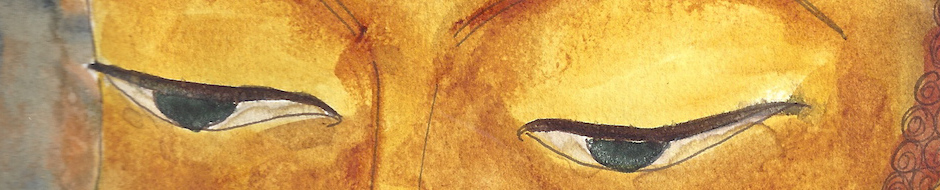
PRESENTED AT THE BUDDHA CENTER ON JUNE 29 AND JULY 2, 2013 AND AGAIN AT THE NEW BUDDHA CENTRE ON SATURDAY, JULY 27, 2024 (REVISED).
Much is made of the fact that the Buddha taught with an open hand, not the closed fist of the professional guru or Brahmanic priest. The implication of this statement is that the Buddha effectively refutes the concept of secret wisdom as such. What the Buddha is really referring to is a subtle wisdom kept secret by an organization. Some think the Buddha’s rejection of secrecy refutes Vajrayana, but the Buddha’s statement in the Pali Canon is far less obvious.
First, he reviles the Brahmans as exemplars of wrong view. Their mantras are secret, like illicit love affairs. The same moon illuminates the night of the Brahmans, and their day the sun, which shine openly and not in secret, like the teaching and training proclaimed by the Buddha. The teaching and the training of the Buddha both illuminate and expose the secret tradition of the Brahmans. The Buddha says the teaching and the training restore the secret wisdom that the Brahmans lost and only preserved in a distorted form. Thus, the Buddha is not attacking the primordial philosophy. Rather, he is criticizing the practice of secrecy in the service of religious and caste privilege. The Buddha discusses it openly, in the service of universal emancipation.
Ultimately, reason alone is not enough to understand the teaching. He refers to “direct knowledge” or gnosis resulting in realization by the suitably inclined individual within a relatively brief time. The teaching is therefore a “secret wisdom” or an “esoteric [direct] knowledge” or gnosis. The comparison of this wisdom with the moon and sun indicates its luminous and transcendent qualities. Wisdom is not ordinary knowledge. It is not accessible by scholarship or even training alone. The salvific wisdom is intrinsically effective through the power of truth. It leads to immediate awakening.
The Development of Wisdom
Kesaputta is a town in Bihar, India. In the Buddha’s time, it was located at the edge of a forest where recluses stopped at night before continuing through the forest the next day. Many different spiritual practices and beliefs came to the attention of the citizens of this town. Today, it boasts the largest Buddha stupa in the world. When the Buddha travelled here, he discussed the wide variety of teachings. There was much doubt and confusion. Therefore, people asked the Buddha how to choose between rival religious ideologies in a multi-cultural world. This situation was not vastly different from the situation in the world today.
In answer, the Buddha rejects the idea that one should base one’s judgment on oral traditions, teaching lineages, hearsay, texts, logic, inferential reasoning, cogitation, pondering, rhetoric, or just because one’s teacher teaches it. Instead, he recommends that one should submit whatever teachings one hears to the test of questioning; one should submit whatever practices one learns about to the test of personal experience.
This does not mean the Buddha rejects the oral traditions, teaching lineages, and the rest. Rather, he directs us to re-examine them in a certain way. Nor is his deference to individual judgment a naive counsel people should “do what they like” based on “what they feel.” Usually this is just an “ego trip.” At worst, it can lead to a completely deluded state. Rather, questioning sacred truth is an endeavour of the utmost gravity. If one should not accept, neither should one reject anything prematurely. Otherwise, one may lose the opportunity to experience insight and truth through further consideration. The recognition of the ultimate impotence of reason is not a counsel to abandon reason. One can transcend reason only by the cultivation of wisdom, through the constant questioning by which one maintains its purity.
The Buddha’s method discovers spiritual truth through the direct questioning of consciousness. He begins with what is obvious. Through the accumulation of observations and inferences, he builds up broad cosmological and ontological insights. This method suggests Socrates’s method of dialectic. This tradition flowered in the 20th century in the West through Husserl, Heidegger, Whitehead, existentialism, and post-modernism. Socrates himself died in 399 BCE, at the age of 71, about the same time as the Buddha. Dr. Herbert Guenther, author of The Teachings of Padmasambhava (1996) and many other books, makes similar statements about Padmasambhava. He calls him the first process philosopher. Others have called the Buddha a 21st century philosopher. Richard Gombrich has called the Buddha the greatest philosopher of all time. The Buddha’s teachings must have been perceived by the Buddha’s contemporaries as nothing less than revelatory. True transcendental philosophy is intrinsically enlightening.
The Buddha declared that this kind of questioning or reasoning into spiritual truth, beginning with the immediacies of human experience, was also to be applied to himself and his teaching and community. He invited others to watch him, evaluate him, criticize him, judge him, and see if he was crazy or deluded or not. He did this over a period of 45 years of continuous teaching. He invited everyone to think about what he said, perhaps to refine one’s understanding or infer implications. In this way, through the power of truth, he built up the teachings in the only way such building up can occur – by speaking and thus influencing the thoughts, words, and deeds of those who hear him. Another great bodhisattva by the name of Jesus put it this way: “A tree is known by its fruit.”
The Purity of the Guru
Similarly, one can establish the purity of a teacher by evaluating what one sees and hears. Its unwholesome fruits will betray an unwholesome teaching; one can discern a wholesome teaching through its wholesome fruits. Thus, by its observed effects one can judge a teaching. There is an interesting book, entitled Stripping the Gurus (2009), by Geoffrey Falk, which applies the Buddha’s counsel in practice, nor are Buddhist teachers exempt. Every disciple of a teacher should read this book as a corrective to the naive enthusiasm to which we are all liable. In the Tibetan tradition, one evaluates a potential teacher for twelve years before accepting him as a teacher. Attachment to the teacher is just another attachment.
This approach to the teaching would mean it would be subject to continuous review, interpretation, reinterpretation, and expansion and change as its theoretical and practical implications are developed and explored. Thus, the Buddha refers to a vertical hierarchy of “levels” of “dharma“ with its dark and bright counterparts.” That the teaching becomes more sublime the better one understands it is clear, but what are the dark and bright counterparts? The Buddha uses the same metaphor with respect to moral causality. He distinguishes between the cause that leads to happiness and the cause that leads to unhappiness. Similarly, the Pali Canon includes a “wrong” eightfold path. Thus, I take dark dharma to refer to wrong beliefs.
In this way, one gains faith in the Buddha based on certainty based on inquiry, including inquiry into the limits of inquiry, rather than some fatuous “faith.” The Buddha says in one famous phrase, “ye sotavanto pamuncantu saddham.” I render this as: “Let the hearers free themselves from faith.” Some take it to mean the opposite, but I read it as a paradox: the way to genuine faith is through faithlessness. True faith does not cling to authority or tradition; it is born of insight.
This is the cutting edge of the diamond of wisdom.
It affirms that reason can weigh spiritual philosophy, yet experience itself lies beyond the reach of the dualistic rational faculty bound to the law of contradiction.
The Primordial Tradition
The Buddha does not repudiate the religion of the Brahmans merely because the Brahmans held different beliefs. The Buddha’s repudiation of Brahmanism is not sectarian. The Buddha rebukes the Brahmans as degenerate remnants of an archaic, long forgotten spirituality. This degeneration afflicts all religions, Buddhism included. This spirituality is even more primeval than the Vedas. The Buddha says, “Now something may be accepted out of faith, yet it may be empty, hollow, and false; but something else may not be fully accepted out of faith, yet it may be factual, true, and unmistaken.” This is “penetrating by wisdom.” The Buddha appears to be alluding to a primordial spiritual tradition. It predates even the Vedas, of which the Vedas themselves are but a reflection. In particular, he derides the Brahmans for their lack of spirituality.
In accordance with the theory of progressive dharma, the Buddha presents a theory of education. Meaning, pondering, desire [sic], will, scrutiny, and striving, culminating in realization “with the body,” follow memorization. This process culminates in “penetration by wisdom.” Another order goes from faith to striving, through visiting, respecting, and listening to the teacher, hearing the teaching, memorization, examining (meaning), pondering, desire, will, and scrutiny.
The Body Witness
Three points are especially noteworthy. “With the body” is an interesting phrase. Realization is not merely mental; it involves the whole being, including what one refers to as the physical. Second, the Buddha refers positively to desire. This is aspiration or energy, the desire for realization, provided it is detached. There is desirous attachment and desire freed from attachment. The third point is the centrality of the teacher. The teacher is central to the traditional Indian practice of guru yoga. Tibet strongly emphasizes this practice.
The Buddha’s concept of guru yoga is different from the naive worship one has come to associate with the term bhakti. Bhakti has led to many abuses, in both Asia and the West. Questioning is the basis of the proper relationship with the teacher . It can only be intimate. It entirely excludes vertical ecclesiasticism. In the noble Buddhist order, the power of ordination devolves to the bhikkhus. True ordination is horizontal, not vertical. It should be freely available to all in principle since all have buddha nature.
The Buddha’s method of dealing with different beliefs is to identify which beliefs one holds in common. Then he extrapolates from these. The term I propose to use to describe this process is “logical syncretism.” No matter where one starts, questioning leads inevitably to the whole view in detail. The teaching is a hologram. A hologram is present in its entirety at every point, but imprecise. The more points one selects, the sharper the image becomes. Similarly, the teaching is present in every word and sentence of every discourse. The more discourses are read, the clearer one’s understanding becomes. The Buddha says he who practises even one sentence of the teaching has the whole thing. Potentially, therefore, it becomes possible to collate the totality of all Buddhist experience. The realization of the holographic nature of the teaching leads to the single vehicle. I have identified this development with the Dharma Transmission to the West.
Ethics
With respect to ethics, the Buddha took a pragmatic view. One should abandon thoughts, words, and actions that lead to unwholesome effects, based on the law of moral causality. Thoughts, words, and actions that lead to wholesome effects should be cultivated. He specifically rejects the Jain doctrine of non-action or inaction. According to this view, one should renounce both positive and negative causes and effects. Wholesome states are the foundation of enlightenment, itself the ultimate wholesome state. Since inaction leads to an unwholesome state, it cannot be the path. This view must be distinguished from the view that pleasure is the criterion of good. The Buddha does not base his ethical precepts on temporary or relative gain or happiness. Rather, he bases them on the ultimate intrinsic gain or happiness that results from them. The ethics of the Buddha are pragmatic, absolute, and essential.
The Buddha rejects the idea that merely following rules, or even an ethical regime of behaviour alone, is sufficient to attain enlightenment. He refers in the first discourse of the Pali Canon to “inferior matters of mere morality.” Rules, even the rules of the monastic system of the Vinaya, are mere “skilful means.” They prepare the ground, but, in themselves, are insufficient; they can even become objects of attachment and sources of delusion (e.g., religion). The Buddha warns his disciples against attachment to rules. In the same way, he dismisses the efficacy of rites, rituals, and dogmatic beliefs. The Buddha says, “Cleansed states cognizable through the eye or through the ear are found in the Tathagata. They are my pathway and my domain, yet I do not identify with them.” Finally, the Buddha provides what Western philosophy has never been able to do – an objective naturalistic ethical basis, the law of moral causality. In the West, the predominant philosophical bias today is that ethics are ultimately arbitrary and irrational. At best, social necessity dictates them. The injunctive “ought” can never be derived from the ontological “is.” Thus, ethics in Western philosophy appear to have no real basis.
The Buddha’s defence of ethics that arises from these considerations is intensely skeptical. Perhaps, the Buddha argues, there is no rebirth and causality is ineffective. The deterministic Ajivika, the hedonistic Lokayata, and the agnostic Ajnana schools that, like Buddhism, arose out of the renunciant movement, held these beliefs. Even so, this life establishes the benefits of ethics in terms of both oneself and others. However, if there is rebirth, one gains the merit of a fortunate rebirth. If moral causality is effective, one experiences positive results too. One neither proves nor disproves the practices of ethics and ethical meditation by anything more than what one experiences in the known life. These principles are the four assurances.
The Buddha also teaches the truth of suffering, with reference to past, present, and future. The past and the present are uncertain, the Buddha says. All one knows about is the present moment, the now. The Buddha shows his innate practicality by grounding understanding in what one immediately knows and observes, and then reasoning from the known to the unknown in a progressive way.
From the fact of suffering, the Buddha inquires into its cause. He comes to desirous attachment as the cause of suffering. The other side of desire is “selective compassion,” or what Westerners so casually call “love,” which means little more today than a serial contract for mutual pleasuring and support. Compassion rooted in attachment contrasts with the universal compassion of one without attachment. The Buddha extends this realization to the past and future. He shows that past states of desirous attachment lead to similar future states. This in turn demonstrates the operation of the law of moral causality. In this way, one builds up one’s understanding by grounding it in what one knows. Then one extends it to what one does not, through a dynamic interactive process of exegesis and experience.
Metta Meditation
From ethics, the Buddha proceeds to the meditation on loving kindness. One finds this meditation all through the Pali Canon. The meditator projects the idea of loving kindness to the four quarters, as well as above, below, across, and everywhere, including oneself, “pervading the entire world with a mind imbued with equanimity, vast, exalted, measureless, without hostility and without ill will.” The Buddha echoes the great Galilean bodhisattva, declaring that love and compassion do not exclude kindness toward oneself.
The meditation on the four quarters is a universal practice found in traditions as diverse as shamanism, indigenous spirituality, Vodun, and the Western esoteric traditions, including Cabala and Wicca. For example, the Navajo have a traditional prayer like loving kindness meditation.
As I walk, as I walk,
The universe is walking with me.
In beauty it walks before me.
In beauty it walks behind me.
In beauty it walks below me.
In beauty it walks above me.
Beauty is on every side.
As I walk, I walk with Beauty.
The Navajo also have a tradition of sand painting that scholars have compared with the Tibetan sand painting tradition.
Thus, the Buddha began with what, for lack of a better term, one might call “common sense” – the universally shared experience of all sentient beings. He combines critical examination with inference to expand this understanding into the teaching. The teaching is not a “revelation” handed down by a “deity.” Nevertheless, the Buddha credited the divine beings, who (tradition says) visited him in the night, with some of his insights. Others came from the Buddha’s own life as a Bodhisattva. The teaching is subject to examination and questioning by reason. Reason itself leads to a “leap” into the transrational and supermundane (reason itself indicates this too).
The teaching is always growing and changing. Rigid formulations, traditions, or organizations cannot pin it down. Ethics, while fundamental, are not the whole thing. Nevertheless, the path and those who follow it are subject to ethical evaluation. Thus, the true teaching always has wholesome qualities. Where such qualities are absent, the teaching is not.
However, one must understand “wholesomeness” in an essential way, not with reference to mere social conventions that are geographically and historically relative and contingent. Many, perhaps most, things esteemed by society are unwholesome, especially in this degenerate age. In such a society, many things shunned may also be wholesome. Many things may be wholesome or unwholesome, depending on attachment and intention. For example, many medicines are toxic and therefore unwholesome, but the administration of a medicine in the proper dose and at the proper time, may be wholesome, depending on due regard to the intention and the conditions (such exceptions are allowed for in the Vinaya). All attachment is unwholesome; therefore, attachment to the wholesome is also unwholesome, and can lead to negative effects including suffering.
The ultimate proof of wholesomeness or unwholesomeness lies in ultimate happiness. One must interpret happiness from the absolute perspectives of moral causality and realization, not merely in a temporary or relative way. Therefore, that which leads to the good is ethical, wholesome, and true. Ethics are not detached from experience. The operation of the law of moral causality grounds them. Still, ethics are only the rind of the teaching.
Revised October 4, 2025
 Dharmata