
PRESENTED TO THE BUDDHA CENTER, NEW YEAR’S EVE, DECEMBER 31, 2013
Vertical Phenomenology of Samsara
| Realm | Sub-realm | Sanskrit Name | Location | Inhabitants | Lifespan | Meditative State |
| NORTHERN POLARITY: A HIGH-ENERGY, IMMATERIAL STATE CHARACTERIZED BY BEING-CONSCIOUSNESS-BLISS (NIRVANA) | ||||||
| (14 additional planes do not communicate with the earth-plane) | ||||||
| FORM WORLD (RUPA LOKA) | ||||||
| Radiant devas | Human beings (before they fell) | 2nd jhana | ||||
| Streaming radiance | Abhasvara | 655,360 miles above the earth[5] | 8 e.[6] | |||
| Immeasurable radiance | Apramanabha | 327,680 miles above the earth | 4 e. | |||
| Limited radiance | Parittabha | 163,840 miles above the earth | 2 e. | |||
| Brahma devas | Brahma gods | 1st jhana | ||||
| Great Brahma | Mahabrahma | 81,920 miles above the earth | 1.5 e. | |||
| Ministers of Brahma | Brahmapurohita | 40,960 miles above the earth | 1 e. | |||
| Members of Brahma’s Assembly | Brahmaparisadya | 20,480 miles above the earth | 0.5 e.[7] | |||
| DESIRE WORLD (KAMA LOKA) | ||||||
| Good Destinations (sugiti) | ||||||
| Creative devas | ||||||
| Devas who control the creations of others | Parinirmita-vasavartin | 10,240 miles above the earth | 9.2 b.y. | |||
| Devas who delight in creation | Nirmanarati | 5,120 miles above the earth | 2.3 b.y. | |||
| Contented devas | Tusita | 2,560 miles above the earth | Bodhisattvas | 576 m.y. | ||
| Time | Yama | 1,280 miles above the earth | 44 m.y. | |||
| Thirty-three | Trayastrimsa | Peak of Mount Sumeru, elevation 640 miles[8] | Asuras (before they fell) | 36 m.y. | ||
| Four Great Kings | Caturmaharajikakayika | Slopes of Mount Sumeru, max. elevation 320 miles | Nature spirits, trolls, goblins, fairies, etc. | 9 m.y. | ||
| Humans | Manusyaloka | Islands in the ocean surrounding Mount Sumeru | ||||
| Jambudvipa | Southern continent | 10-120 y. | ||||
| Purvavideha | Eastern continent | 250 y. | ||||
| Aparagodaniya | Western continent | 500 y. | ||||
| Uttarakuru | Northern continent | 1,000 y. | ||||
| Bad Destinations (apaya) | ||||||
|
Anti-gods |
Asura | Base of Mount Sumeru | Anti-gods | |||
| Animals | Tiryayoni-loka | Animals | ||||
| Ghosts | Pretaloka | Ghosts | ||||
| Hells (divided into eight hot and cold hells) | Naraka | Hell-beings | ||||
| SOUTHERN POLARITY: A LOW-ENERGY, MATERIAL STATE CHARACTERIZED BY ILLUSION-IGNORANCE-SUFFERING (SAMSARA) | ||||||
Buddhist cosmology is nowhere explained in the Buddhist sutras in its totality as a system. Yet its essential architecture appears in all schools, both Hinayana and Mahayana, with only minor differences, based on a systematic analysis and synthesis of scattered references found throughout the Pali Canon. Thus, it must have been a topic of intense scrutiny, having arisen during the pre-sectarian period that is closest to the original teachings of Shakyamuni Buddha.
Consequently, this discussion cannot be assigned to any particular sect. It underlies and unifies the whole Buddhist worldview, even the Theravada, which commonly claims that the Buddha did not present an ontology. In this talk, I will present a synthetic overview of Buddhist cosmology and ontology in the context of contemporary post-Newtonian science and explore its implications for the spiritual path. One is struck by the degree to which the Buddhist worldview anticipates contemporary scientific discoveries, once one overcomes the misosophy of “scientism” and “philosophical materialism,” which true science transcended long ago. That this is not generally recognized or accepted testifies to the ignorance that masquerades as enlightenment today. Nor is ontology irrelevant to the topic of spiritual development, as some might assert, based on a selective reading of the texts. Rather, in the light of the Buddhist revelations concerning the fundamental and ultimate nature of reality, Buddhist beliefs concerning spiritual practice acquire a clarity that only enhances the prevalent psychological interpretation, which also suffers from the accusation of subjectivity. Unfortunately, what Evans-Wentz referred to as the “long dark age of the West” still blinds us to the insights that might be derived from realizing that scientism, as distinct from science, does not only not present a comprehensive picture of reality; it actually blinds us to it, in the service of a contemporary ethos that increasingly threatens to destroy the world of nature and humanity in the relentless pursuit of competition, property, and mindless consumption that stands opposed to the three primary facts of existence: selflessness, impermanence, and suffering as taught by the Buddha.
Buddhist cosmology divides experience both vertically and horizontally. Horizontally, the Buddhist discourses describe worlds or world systems separated by vast regions of empty space. These worlds appeared in great spheres that emerged out of a state of potentiality, expanded, contracted, and disappeared over lengthy periods ranging from millions to trillions of years. In the largest sense, this fourfold process of origination, evolution, devolution, and potentiality has no beginning and no end – it is infinite and eternal in extent and duration. The spherical universe is itself organized into (more or less) spherical stars and galaxies that themselves move in (more or less) spherical orbits, and even larger collections of galaxies. The latter fact that has only been recently substantiated by science. The Buddha also describes the destruction of solar systems by supernovas, which proceed in seven stages or phases (the so-called “seven suns”), characterized by the cessation of rain and the consequent disappearance of vegetation over a period of hundreds of thousands of years, followed by the drying up of the rivers and oceans and finally the incineration of the earth itself. String theorists also posit that universes themselves coexist as holographic diffraction patterns in a two-dimensional plane that appear in our universe as black holes. While not specifically indicated by Buddhist cosmology, such a view is certainly consistent with it.
This quaternary dynamic structure of origination, evolution, devolution, and potentiality also describes the infinitesimal. In fact, it is the fundamental process structure of becoming itself. Phenomenal reality is nothing other than process, cycles occurring within cycles within cycles, driven by the law of causality. What we call “matter” is not a “stuff,” but rather a particular kind of process or system of processes. This description largely accords with the modern scientific conception of the physical nature of reality since the downfall of philosophical materialism. The mathematician Alfred North Whitehead in his book, Process and Reality (1929), describes it, for example. Similarly, Buckminster Fuller believed that the world is geometry.
The Buddha also describes a vertical dimension, ranging from a high-energy, abstract polarity to a low energy, “material” polarity that also accords very well with the world view of modern physics. Buddhist cosmology divides this vertical continuum in many ways, starting with a twofold division into formless and form “realms” and ending with a division into 31 fundamental planes of “vibration” or existence.
According to Buddhist cosmology, human beings inhabit the fifth realm, counting from the bottom, or the 27th realm, counting from the top, of these 31 planes of existence. The human realm is also the lowest (seventh) realm of the so-called “happy destinations,” represented as a flattened inverted triangular island-continent that floats in the ocean to the south of Mount Sumeru, the shape of which suggests the Indian subcontinent. This represents the earthly realm consisting of four continents. Sumeru (lit. “excellent” or “wondrous mountain”) is the Buddhist representation of the universal archetype of a central world axis, usually represented as a mountain, tree, or pole. Commonly identified with Mount Kailash or Kangrinpoque in the Tibetan Himalayas, this identification is clearly symbolic. In fact, geographically, and here I am primarily interested in physical facts, Sumeru clearly represents the rotational and magnetic axes of the earth. The four continents represent the continents of the earth. The shape of the southern continent, where human beings live, clearly corresponds to the Indian subcontinent. Thus, the western continent would correspond to the African-South American landmass, which we now know were originally joined; the northern continent to North America and Greenland; and the eastern continent to Eurasia. It is now known that several supercontinents have formed and separated throughout the earth’s history. The Buddhist description appears to allude to a specific moment in the earth’s geologic history when the continents had just this formation. According to at least one animation I have seen, this was the situation about 120 million years ago. In this interpretation, then, the “peak” of Mount Sumeru would correspond to the North Polar Axis of the earth, the magnetic pole of which, like Shambhala, “wanders.” The ocean around its base corresponds to the “one world ocean” in which the continents drift. The “one world ocean” is clearly shown in the Dymaxion map of R. Buckminster Fuller.
Mount Sumeru includes the realm of the anti-gods, who inhabit its base; the realm of the Four Great Kings, who occupy its four slopes; and the realm of the Thirty-Three gods, Vedic and post-Vedic demigods who occupy its truncated apex. Thus, Mount Sumeru is represented as a truncated four-sided pyramid. This architecture resembles that of Mount Kailash as well as the ziggurats, built in the ancient Mesopotamian valley and western Iranian plateau, and similar structures, called step pyramids, also found in Egypt, Europe, Mesoamerica, South America, North America, and Indonesia. Floating in the air above Mount Sumeru are realms of beautiful, pleasure-loving beings who live long lives in great enjoyment (the Yama realm), beings who experience a deep, serene happiness, free from the frantic sensuality of the lower heavens (the tusita realm), two realms associated with creativity, and three God-realms (the Brahma realm). Below the realm of the humans and the anti-gods are the realms of ghosts, animals, and hell-beings, the latter divided into eight hot and eight cold hells.
It is fashionable to interpret the realms of Buddhist cosmology psychologically, as representative of distinct types, stages, or degrees of consciousness or conscious realization. This point of view is certainly valid, but this does not mean that the 31 planes of existence are subjective. According to the Buddhist worldview, psychological and ontological states are opposite sides of the same coin. Reality itself is ultimately resolvable into mental states, matter itself being merely a delusion of consciousness. In this discussion, I intend to focus on the neglected ontological aspect of the Buddhist cosmic conception. I will focus on the realms that we perceive and/or that interact or communicate with our own, “earthly” realm. This description finds correspondences with certain modern speculative theories. Dr. Jacques Vallée is one of the most rational individuals currently exploring this area. However, while these correspondences may be interesting, it is not my intention here to argue for or against these theories or to endorse any point of view, but simply to present Buddhist cosmology from an historical and scientific perspective.
According to the discourses, all the 31 planes of existence, corresponding as they do to “levels” of conscious realization, are inhabited by sentient beings. This must be true because, as in quantum physics, it is the act of observation that gives rise to phenomenal reality. This is also true of the horizontal dimension of the world. The difference is that the sentient beings that inhabit the realms above the human realm are far more intelligent, knowledgeable, beautiful, powerful, faster, and long-lived than we are, by many orders of magnitude. They are not, however, necessarily more spiritual than humans. Many are decisively less spiritual. Because of their great gifts, inherited from past karma, many of these beings are relatively complacent, and simply enjoy their long lives, which can last millions, billions, or even trillions of human years. However, at the lower end of the scale, the inhabitants of the Brahma worlds (mahabrahmas) may and do take an interest in human affairs. These beings occupy the highest realm that interacts with humans. The higher Brahma world is the lowest world in the system of 31 planes that is not subject to periodic destruction, whereas all the planes including and below the lower Brahma realm are subject to the fourfold process of origination, evolution, devolution, and potentiality already discussed. Beings within these realms are, however, still subject to this process. Otherwise, their merit would not be exhausted and they would not be reborn. Thus, the Brahma world is the highest and subtlest plane of phenomenal existence. The best-known inhabitant of this world is Mahabrahma Himself, aka “God,” who erroneously believes Himself to be the Creator of the Universe because He is the first being to be reborn after the destruction and reappearance of the universe. In Gnosticism, He is called the Demiurge (Gk. demiourgos, “creator”).
The Mahabrahma Sahampati convinced the Buddha to preach following his Enlightenment for the sake of all sentient beings. Thus, although ignorant and deluded in some ways, mahabrahmas are not actually malicious. The Buddha encouraged his disciples to be reborn there, as an intermediate step towards enlightenment, and provided the well-known loving kindness meditation to achieve this goal.
The so-called “divine race” inhabit the next lower world associated with creativity. These are cosmic capitalists, divine beings who control the creations others. These correspond to the anthropomorphic gods of the pagan polytheistic pantheons, which in many traditions (e.g., Vodun) are literally nourished and sustained by the offerings they receive. Mara, the tempter of the Buddha, is often said to reside in this realm, although he is also associated with the demonic anti-gods. I will be speaking more about this later.
Next are the bodhisattvas, who are reborn in the human world as Buddhas. Each Buddha initiates an age, or dispensation of dharma, which does not end until his dharma is forgotten. Thus, we are now in the Buddha-dispensation of Sakyamuni Gotama, which will last for only about five thousand years. We are, therefore, now at the midpoint of the Shakyamuni-dispensation. The bodhisattvas inhabit the Tusita (“joyful”) realm, the second realm above the human.
The realm of the Four Great Kings is the closest realm next above our own. The nature spirits, dwarfs, fairies, dragons, goblins, trolls, and similar beings of all traditions, of varying degrees of ethical purity, inhabit it.
Finally, we find the anti-gods and four human types. The latter range in longevity from ten to 80,000 years. Our own human species, which is merely one of many, lives to the south of the base of Mount Sumeru. Currently we live about 120 years, although originally, we were much longer-lived than this. During the age of the chakravartins (lit. “rulers of the universe”) human beings of the different continents were able to travel between the continents, using a flying machine called a cakraratna.
Whereas human beings inhabit four great continents in the one world ocean that surrounds the base of Mount Sumeru, the anti-gods inhabit the ocean itself immediately surrounding the base. The word “a-sura” was interpreted to mean “non-sura,” i.e., not a sura, a synonym for deva (literally, a “shining being” or luminous energy being). Deva can also be translated “celestial dweller” or “star.” In these talks I have translated them as the more generic “divine beings.”
Asura is often translated Titan, demigod, anti-god, or demon. The anti-gods are described as addicted to the passions of wrath, pride, envy, insincerity, falseness, boasting, and bellicosity. They are dominated by ego, force, and violence. At least some anti-gods are malevolent. As with all the six classes of sentient beings, anti-gods may be reborn as human beings, and human beings may be reborn as anti-gods. Because humans and anti-gods occupy essentially the same plane, i.e., the one world ocean surrounding the base of Mount Sumeru, there is considerable interaction between them. Anti-gods enjoy a much more pleasurable life than humans do, but they are plagued by envy for the divine beings.
Anti-gods and human beings are alike in that we both have shared a similar fate. Both human beings and the anti-gods originally occupied a much higher realm in the Buddhist hierarchy. Anti-gods originally lived in the realm of the Thirty-Three Gods on the peak of Mount Sumeru, but they were cast down to the foot of the mountain due to their drunkenness. Thus the anti-gods and the divine beings of the Thirty-Three Gods engage in constant conflict, in which human beings also become embroiled.
The anti-gods were not always regarded as evil. In the Rig Veda (1500-1200 BCE), anti-gods were considered a type of divine being, such as Asura Varuna, the god of the celestial ocean, the underwater world, and law and order, as well as morality, societal affairs, and nature. The term Asura (lit. “lord”) was originally associated with individual divine beings, not a distinct class of beings. The anti-gods became a separate class of being during the late Vedic period (1000 BCE–500 BCE). In the earlier Vedic texts, the anti-gods were often viewed as the older and stronger siblings of the divine beings—powerful and beneficent. However, the later Vedic texts began to document a growing conflict between the anti-gods and the divine beings, in which the divine beings were often victorious. According to the Bhagavad Gita, the anti-gods are described as vicious, proud, arrogant, conceited, angry, harsh, and ignorant. This shift in perception reflects a growing conflict between the older, dominant cult of anti-god worship and the rising cult of deva worship. Initially, the anti-gods were non-anthropomorphic and formless gods, in contrast to the more anthropomorphic divine beings. The anti-gods were also seen as the guardians of the natural and moral laws of ṛita, the great principle of cosmic order that regulates and coordinates the operation of the universe, like the concepts of dharma and karma. On the other hand, the deva worshippers were primarily concerned with power, might, fear, submission, and the maintenance of the status quo. Interestingly, it was also during the late Vedic period that women were stripped of their traditional rights and privileges, demoted to the status of property—a development that the Buddha opposed. However, this social shift was reinstated shortly after his passing, around 400 BCE, by the arhants at the First Buddhist Council. Thus, the division between the anti-god and deva worshippers appears to parallel a social schism that occurred during the late Vedic period, culminating in the ascetic counterculture of the 6th and 5th centuries BCE. In Buddhism, the anti-gods are viewed as inferior deities who are never satisfied and continually strive for improvement. This is paradoxical because the Buddha opposed the Brahmanic establishment, which was supported by the deva worshippers and reinforced the caste system. The Buddha saw this as a degenerate remnant of the primordial tradition, which he sought to restore. This schism reflects a conflict between the adherents of the old gods that continues to this day, with worshippers of the old gods attempting to restore their primacy against the newer deities of oppression. A similar conflict can be found in Egyptian mythology, where the old gods, like Set, once not regarded as evil, were later demonized. This principle of cosmic conflict became entrenched in later religions, such as Zoroastrianism and Christianity. In the Iranian tradition, the anti-gods, particularly Asura Mazda (Ahura Mazda), the personification of Wisdom, retained their privileged status, while the divine beings were demonized and cast down.
Similarly, human beings originally occupied the radiant or splendid realm, next above the Brahma world. Here we dwelled as beings of light or pure energy, characterized by delight and joy. The original transhumans or divine humans were psychologically individual but physically alike. Plato describes them as celestial bisexual spheres of pure energy. When a universe re-emerges from a state of potentiality, it is immediately populated by humans from the Abhasvara realm. According to modern scientific reckoning, this occurred about 14 billion years ago, although this is now in doubt. The first humans were not like modern humans. They shone in their own light, flew without mechanical aid, lived for an extraordinarily long time, and did not require physical nourishment. They were more like a type of inferior deity than contemporary human beings. This was the age of the “universal rulers.” However, gradually we developed a taste for physicality. Our bodies became heavier and more material. We lost our intrinsic luminosity. Our bodies became more differentiated. Our lifespan decreased. We divided into two genders and began to reproduce sexually. We began to hunt and eat the flesh of animals. Territoriality, property, greed, theft, violence, and criminality gradually overtook us. Social distinctions and government arose. The critical transition to humanity appears to have begun during the hunter-gatherer stage of human civilization. This arose about one to two million years ago, when Homo erectus discovered fire. It culminates in the Neolithic Revolution, which occurred about 10,000 years ago. This seems to be the time when the divine humans began to enter the physical primate evolution through the process of rebirth or transmigration. This was perhaps facilitated by the ingestion of psychedelic plants by early primates, as suggested by Aldous Huxley, Terrence McKenna, Graham Hancock, and others, thus opening a “door” to the higher realms.
Anti-gods perceive divine beings in the same way that animals perceive humans. Humans perceive animals consistently, unless they are tiny, but divine beings and anti-gods only rarely. Anti-gods are often confused with hell beings. The objection to divine beings that we do not see them disappears entirely when one realizes that one is comparing orders of sentient beings potentially comparable to the difference between an ant and a man. A divine being is no more visible to a man, than a man is to an ant, even though the latter may be crawling across his hand. The argument works the other way too. When was the last time you communicated with an ant? Yet ants and human beings inhabit the same terrestrial space. Thus, it is not necessarily true that the planes of the world are ontologically separate, any more than the higher dimensions of strings are separated from space and time in string theory. All the dimensions may co-exist and yet be invisible to each other. Similarly, we have millions of radio and television programs and cell phone conversations passing through our bodies right now, but we do not perceive them. Perhaps this is why we have yet to “discover” extraterrestrial civilizations, some of which must be millions or even billions of years older than Homo sapiens. Perhaps they are right here, right now, but we simply cannot see them.
To appreciate a higher-energy being, one must adjust one’s own energy-vibration-frequency to their level. This is possible in theory by concentrating consciousness, increasing its “vibration.” Mind itself is the universal substrate of reality. Thus, all of reality is, in principle, accessible to it. This can be achieved through meditation or a variety of mind-altering techniques, both physical and psychological, including the ingestion of psychedelic substances, but one’s perceptions will be limited by one’s cognitive capacity, which is largely a matter of karma, since all human beings are capable of enlightenment in principle, and are already essentially enlightened. This capability is the tathagatagarbha, the Buddha-potentiality. On the other hand, a Buddha has transcended the world completely. Therefore, he can travel in a “mental body” to any part of the world and communicate with the beings that inhabit other realms without limitation or distortion. Thus, he has a perfect understanding and knowledge of reality.
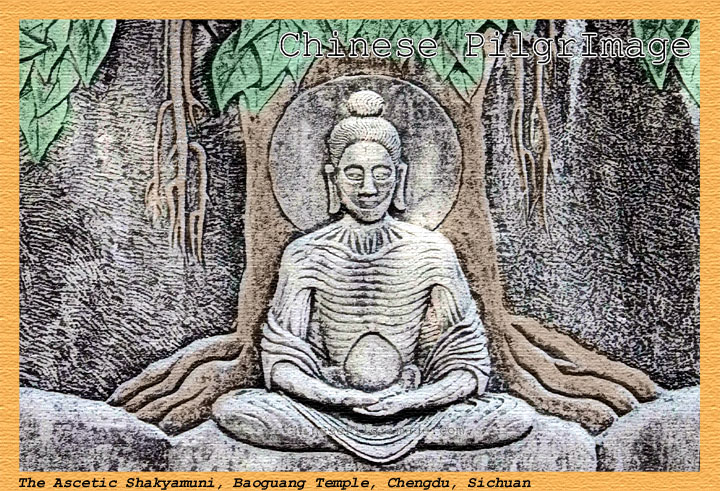
When we consider spiritual development in this way, from the perspective of Buddhist cosmology, we see that we must “ascend” the “great chain of being” from the realm that we inhabit, the so-called earth plane, step by step. The life of the Bodhisattva Gotama is the paradigm of this process in the current age. Even Gotama experienced two false starts before attaining enlightenment, after renouncing the world at the age of 29. First, he endeavoured to achieve transcendence by refining his consciousness to the ultimate degree. Although he experienced the highest possible meditative state, the fourth formless meditation, in which he realized the highest plane of the world, the sphere of neither perception nor non-perception, he rejected it as unsatisfactory. Subsequently he plunged into a six year experiment in extreme asceticism, including self-mortification, living and sleeping in charnel grounds, mind control, breath control, and extreme fasting. Despite all this effort, all he achieved was bringing himself to the verge of dying. It was only after rejecting all these practices as intrinsically worthless that he approached the periphery of enlightenment. He just sat beneath a tree, and practised mindfulness of the breath and the body with intent mental concentration, insight, and detachment. Then he experienced his final challenge – his famous encounter with Asura Mara.
The character of Mara appears to have two distinct aspects which may be related to the conflict between the anti-gods and the divine beings. In one aspect he is a divine being, a resident of the plane of the divine beings that wield power over others’ creations, the highest realm of the desire realm. Mara is commonly understood to be the chief of this realm; in another aspect, he is a demon or anti-god. It appears to be in the latter aspect that the Buddha encountered him on the cusp of his enlightenment. This story is well known and need not be repeated here. My main point is that Mara was intensely opposed to the Buddha’s enlightenment, for by becoming enlightened Gotama would not only escape Mara’s domination; Mara knew that he would lead countless others to do so too. Here we see the envy and hatred of the divine beings for which the anti-gods are notorious. Yet to become enlightened Gotama also had to conquer Mara, as the chief of the anti-gods who block the way to the higher planes. From this we may infer that the anti-gods, in their war against the divine beings, are also opposed to human spiritual progress. Psychologically we would say that the anti-gods are the personification of the blind forces of desirous attachment, the instinctual complexes that bind humanity to the world and the animal state and blind us to spiritual realization. Mara must be encountered and overcome for the spiritual quest to be successful. All the spiritual traditions of humanity attest to this “dark night of the soul,” the experience of agitation, confusion, and suffering without which the spiritual quest is fruitless.
Nevertheless, as I have already mentioned, this Western psychological interpretation is only one side of the coin; the other side is the objective ontological existence of the anti-gods themselves. Thus, contemporary humanity is situated at a great crux. On the one hand, we can remain in the state of worldly attachment, which is where the anti-gods want us to be, in the same state as the anti-gods themselves – ignorant, lustful, violent, and self-destructive, under the dictatorship of “those who control the creations of others.” On the other hand, we can dare to encounter, challenge, and overcome the anti-gods themselves, and through an act of will, master them. Some of the anti-gods are Buddhists or at least admirers of the Buddha. This cannot be achieved by repression, however, or by reliance upon some fatuous vicarious atonement, for the anti-gods stand guard as sentinels at the base of Mount Sumeru, challenging and obstructing all those who endeavour to ascend to its peaks. They cannot be evaded or avoided. They arise out of the watery depths of the unconscious and strive with all their power and might to possess and overwhelm all those who dare challenge them, dragging us down into the very chaos in which they exist themselves. This is the lesson par excellence of the enlightenment of the Buddha.
One is struck by the profound correspondence between Buddhist cosmology and the post-Newtonian scientific understanding of the nature of reality. This is even more remarkable when one compares the Aryan cosmic conception with the Semitic worldview, with its limited notion of a six-thousand-year-old universe, creation biology, flood geology, the unique spiritual status of the human species, racialism (“the chosen race”), and geocentricity. In addition, the Semitic tradition introduced the concept of linear, apocalyptic time — the belief that history is a straight-line culminating in an end, rather than the cyclical or eternal view held by Aryan and Asian traditions. It anthropomorphized the divine, portraying the supreme principle as a jealous and emotional deity, and imposed a rigid moral absolutism dictated by divine command rather than discovered through nature or reason. It laid claim to divine ownership of land, reserved true prophecy to a narrow lineage, asserted the infallibility of one set of scriptures, and demonized all rival gods as evil spirits. All these delusions stand in sharp contrast to the broader, more universal, and naturalistic cosmologies of the Indo-European and Asian worlds, where multiplicity, cosmic law, and spiritual evolution were accepted as self-evident truths. This led to the blood feud between the new science and the Church that in turn has led to the virtual abandonment of any notion of a vertical (spiritual) axis of existence in the West. This has led to the disasters of scientism, philosophical materialism, “scientific” socialism, social Darwinism, and fascism, the results of which not only threaten human civilization, but the very survival of the planet itself. I have documented some of these remarkable correspondences in this talk, which include:
- The reality of astronomical distances and vast cycles of time, including other stars, worlds, and sentient beings throughout the universe and beyond;
- Interstellar space;
- The big bang and the expansion, contraction, and ultimate destruction of, not just this universe, but many universes besides our own;
- The extent of the solar system;
- That reality has no origin and no creator;
- The ubiquity of the law of causality;
- The complete interdependence of phenomena, which was only proved in the 1960s by Bell’s Theorem;
- Periodic destruction of planets by supernovas;
- The reality of higher dimensions, characterized by different frequencies or vibrations of energy, all real and coexistent but many of which are invisible and intangible to each other;
- Time dilation;
- The non-reality of matter – virtuality;
- The non-uniqueness of human sentience – universality of consciousness;
- Multiple human species;
- The primacy of the mind (the quantum act of observation);
- Process philosophy;
- Continental drift;
- Vast cycles of terrestrial, historical time, characterized by periodic world cataclysms;
- One world ocean;
- The universality of sentience and thus the complete interconnectedness of all living beings, with no essential difference between them;
- The genetically programmed longevity of Homo sapiens of 120 years;
- The reality of ancient air and space travel; and
- Finally, the reality of psychic abilities, which are just beginning to be classified and studied by science.
I hope the foregoing will convince even the most skeptical that the belief, prevalent in some schools of religious Buddhism, and based on an over-reliance on two texts, that the Buddha did not teach a theory of the nature of reality, is factually false. Thus, we may open our minds up to the realization that we do not pursue meditation in a vacuum. Spiritual development is not a purely mental or subjective activity, as taught by some self-styled modernist “Buddhists.” It is not “relaxation response” or psychotherapy. Rather, it expresses a profoundly universal teleology through which one may discover, not merely abstract metaphysical or psychological insights, but profound realizations concerning the fundamental nature of what we naively refer to as “physical” reality, which were well known to our ancestors at least thousands of years ago.
Revised Saturday, April 26, 2025 CE
Appendix
 At the request of a student I have added the following account of the preta world, i.e., the world of the spirits of the dead, commonly but mistakenly referred to as “hungry ghosts,” from the Chinese èguǐ. The pretas inhabit the paraloka or “other world,” and are characterized by insatiable hunger and thirst as well as being subject to immoderate heat and cold. This is one of the six classes of rebirth, one of the “unhappy destinations” below the human but above hell beings. Mostly they dwell on the earth, in desert and waste places, and thus may be counted as a “near-earth” realm, though they are normally invisible to humans, except when one is in a certain mood or mental state. When they do appear, they may appear during the day or the night, and may be recognized by their relatives. We, however, are visible to them. Generally human in appearance, the pretas are rather cadaverous, much like the traditional image of the zombie, although they can also appear as smoke or fire. The character of the smoke monster in the tv series Lost, which incorporates many Buddhist motifs, has the appearance of a preta. They have huge appetites but are unable to satisfy themselves, and feed on revolting and disgusting substances such as corpses and feces. Some pretas prey on human blood, like the vampire. Rebirth as a preta is the result of karma, like all rebirths, especially falseness, corruption, compulsiveness, deceit, jealousy, greed, and addiction. Mostly they are pitiable creatures, and people often leave food offerings to them in the temples and elsewhere. However, an offering directly given cannot benefit a preta – the merit of the offering must be transferred also. This is an interesting detail that shows that the concept of dedicating merit (puṇyapariṇāmanā) was established by the time that the Petavatthu (“Stories of the Departed”) in the Minor Anthologies (Khuddaka Nikaya) of the Pali Canon, was composed, perhaps 150 years or so after the death (parinirvana) of the Buddha (Law, History of Pali Literature, p. 36), although others place it as recently as the second century BCE (Obeyesekere 2002, 139). Thus, the view, held by some early scholars, that the practice of transferring merit is (a) a Mahayana practice exclusively, and (b) late (5th to 7th centuries CE) is definitely disproved.
Notes:
1. These are Jambudvipa (“land of the Indian blackberry tree”), Purvavideha (“land of the thorntree”), Aparagodiyana (“land of the kadam tree”), and Uttarakuru (“land of the kalpa tree”), located in the south, east, west, and north respectively. Uttarakuru is the abode of the most advanced humans, who live for a thousand years and are, interestingly, communists. Our own species of human lives on Jambudvipa, characterized by the shortest lifespan of the four types.
2. These are Vaisravana, “he who hears everything”; Virudhaka, “he who causes to grow”; Dhrtarastra, “he who upholds the realm”; Virupaksa, “he who sees all,” associated with the colours yellow, blue, white, and red; the north, south, east, west; and various symbols, including the umbrella, mongoose, stupa, sword. pipa (lute), serpent, stupa, and pearl. The function of the Four Great Kings is to report to Sakra, the chief of the realm of the 33 gods, on the moral state of humanity.
3. Dr. J. Allen Hynek (1910-1986), noted astronomer and professor, was one of the most respected figures in the scientific study of the UFO phenomenon. Prophetically, in 1980 he declared at the Proceedings of the First International UFO Congress, “I hold it entirely possible that a technology exists, which encompasses both the physical and the psychic, the material and the mental. There are stars that are millions of years older than the sun. There may be a civilization that is millions of years more advanced than man’s. We have gone from Kitty Hawk to the moon in some seventy years, but it’s possible that a million-year-old civilization may know something that we don’t … I hypothesize an ‘M&M’ technology encompassing the mental and material realms. The psychic realms, so mysterious to us today, may be an ordinary part of an advanced technology.”
4. Ants appeared in the evolutionary record about 100 million years ago. Homo appeared about 2.5 million years ago. Consequently, the difference between ants and men is only about 97.5 million years, far less than the trillion year life span of devas, so it is clear that the difference between devas and men is of an order of magnitude of at least 10,000 times greater than that between ants and men.
5. The original sources of course do not indicate miles. To arrive at miles I have used an equivalence of 1 yojana = 8 miles (13 km). The distance from the Radiant Devas to Mt. Sumeru is comparable to the distance between the earth and the moon.
6. According to one interpretation, an eon (mahakalpa) equals 1.28 trillion years, so the Abhasvara devas live about ten trillion years. (“Trillion” here is defined as one thousand billion, or ten followed by eleven zeroes.) In another interpretation it is 10 to the power of 140 (i.e., ten followed by 140 zeroes) – a much larger number.
7. The previous three figures are as given in the Sarvastivada tradition. The Vibhajyavada tradition has 1, 0.5, and 0.3 eons respectively.
8. This figure corresponds very closely to the outer limit of the earth’s atmosphere, the exobase (approx. 434 miles). The realm of the glorious devas approximates the distance of the earth from the sun; the Pure Abodes, Venus and Mars; and the Formless world, Saturn and Uranus. Thus, the maximum extent of the 31 planes of existence – somewhat over one billion miles – approximates a solar system.
Further Study
Jacques Vallee Discusses UFO Control System
Where Science and Buddhism Meet: Part 1
Where Science and Buddhism Meet: Part 2
Creativity, Cosmology and Communion: A Buddhist View of Psychedelics
Buddhism and Metaphysics: Understanding the Nature of Reality
 Dharmata